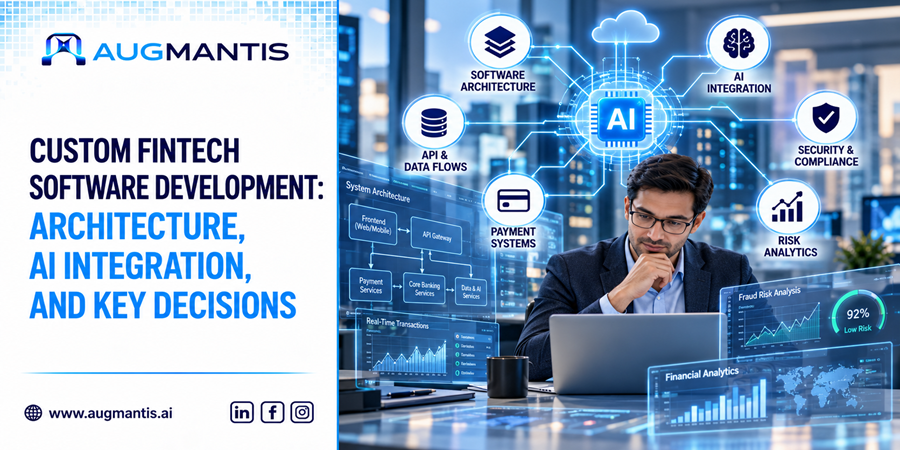
Fintech app development is not merely about delivering financial services over the internet. Transaction apps have to be capable of carrying out reliable transactions, lending websites should have accurate client data, and banking systems are expected to secure private information. With custom fintech software development, companies can create apps according to their business needs rather than being fully dependent on ready-made solutions.
Thanks to the growing popularity of artificial intelligence, financial institutions are able to automate some procedures, find suspicious transactions, and process information effectively. However, the right architecture selection and effective integration of AI are necessary for the creation of reliable financial software.
1. Why Custom Fintech Software Development Matters
A ready-to-use program will suffice for basic requirements, but a business may face some challenges in cases where customization of payment processes, reporting, or system integration is required.
Building for Business Growth
Custom development ensures that a business creates features that fit into its processes. For instance, a lending firm can develop an application using its criteria for determining eligibility, reviewing applications, and managing loans.
Thinking about the future is also key. The system needs to cope with increased traffic and more integrations without having to undergo total redevelopment. Businesses should be able to add new features without interfering with the existing ones.
2. Understanding Fintech Software Architecture
Architecture defines how an application stores data, communicates with other services, and deals with errors. Well-thought-out architecture simplifies maintenance, scalability, and troubleshooting of financial applications.
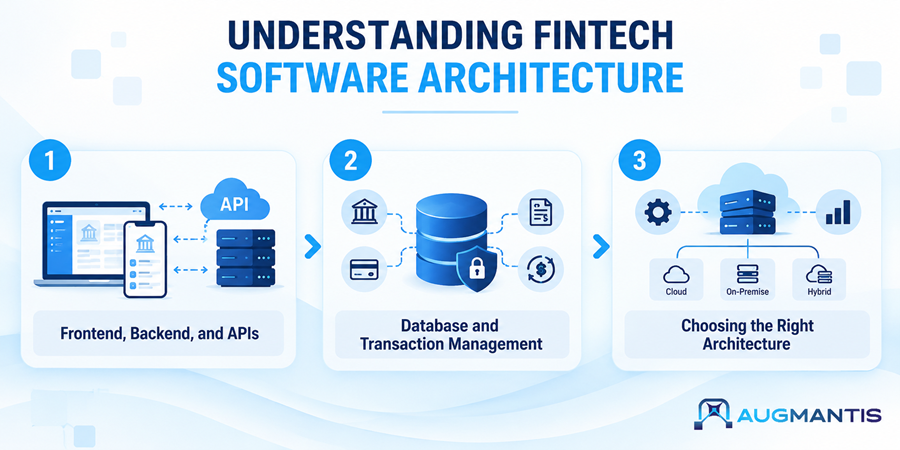
Frontend, Backend, and APIs
The frontend contains interfaces like the mobile banking app and payment dashboard. The backend deals with business logic, authorization, and transaction processing. The APIs link the system to the banks, payment gateways, and accounting system.
When developing AI FinTech software in the USA, the development team needs to factor in the communication between the AI components and the above systems. In case there is an outage at the third-party service, it shouldn't be left to the customer to wonder about the transaction status.
Database and Transaction Management
Financial data has to be precise even where concurrent transactions take place. It is common practice to use relational databases for transaction-consistent structured financial data.
It helps to have a reliable ledger, reconciliation process, and audit trail to enable teams to trace the transactions and solve any problems arising therefrom. Backup and recovery processes are just as important.
As far as payment application development goes, developers must factor in duplicate requests and transactions that are interrupted. There are ways in which duplicated requests can be avoided as well as how to confirm a transaction has been done.
Choosing the Right Architecture
While microservices facilitate scaling up of various components on larger platforms, they make maintenance more difficult. A modular monolith is more appropriate when working on smaller applications. It all comes down to the demands of the business.
3. Security and Compliance in Fintech
It is wise to look at security from the start because financial software deals with customer details and transactions. If there is a problem with one integration, then even though the software itself may be secure, the information is exposed.
Protecting Financial Data
Encryption, multi-factor authentication, access control measures, and frequent vulnerability tests are used to secure the information. The employees and connected services must have access to only that data which is necessary to perform their duties.
It is recommended that organizations keep an eye on any suspicious activities and review the access permissions from time to time.
Addressing Compliance Requirements
Privacy laws, identity verification, money laundering prevention measures, and PCI DSS compliance are some of the factors that companies have to keep in mind based on what they are offering and where.
The regulations relevant to AI financial solutions in the USA have to be taken into account by companies that are considering using AI financial solutions.
4. How AI in FinTech Improves Financial Operations
AI in FinTech aids the financial business sector to identify patterns and analyze data, in addition to eliminating repetitive activities. The effectiveness of artificial intelligence largely depends upon the problem that needs to be addressed, the quality of information available, and its implementation.
Fraud Detection and Customer Support
Machine learning techniques can recognize some suspicious transactions that cannot be found by rule-based algorithms.
Suspected transactions do not have to be considered fraudulent right away but can be verified.
AI is used in credit scoring and forecasting; however, AI models for lending purposes must be carefully analyzed in terms of their accuracy and fairness.
In customer service, AI assistants help to answer basic inquiries related to payments, accounts, and loans. Good AI solutions for FinTech ensure that AI assistants have access to approved information resources and human operators when necessary.
5. Integrating Generative AI into Fintech Software
AI generators could assist financial staff in reviewing documents, retrieving information, and performing certain administrative activities through automation. However, its application will largely depend on integration within existing workflows and proper validation of results.
Document Processing and AI Agents
Financial institutions constantly deal with contracts, invoices, statements, and loan applications. The generative AI for FinTech can summarize the documents, extract relevant fields, and find out any missing information.
For instance, an AI agent may generate a summary of the loan application for further consideration by an employee. Validations must be done prior to including any extracted information in the core financial system.
Ready to Implement AI in Your Business?
From strategy to deployment, Augmantis helps you integrate AI into your workflows with scalable, future-ready solutions designed for real business growth.
Get Started with AI →Also, the AI agents can coordinate various routines like validation of the invoice details or approval summary preparation. Payments and account modifications must still go through the proper permissions.
Connecting AI to Trusted Information
A retrieval-augmented generation (RAG) process enables an AI system to extract relevant information from authorized sources before providing any answers. This can be used for internal policy research and customer service, as long as the information is up to date and the authorization process is followed.
Before implementation, organizations should test these systems on real queries. If an AI system cannot obtain reliable information, it should not give any answers at all.
6. Selecting AI FinTech Solutions in the USA
While assessing AI FinTech solutions in the USA, the most important aspect is to see whether the solution is solving any practical problems for the business operations.
Evaluate Business Needs and Data
Begin with a particular application case, e.g., reduction in document reviews and the customer onboarding process. Process metrics like time taken for the process, error rate, and cost of operation can be used to quantify the outcome.
Data quality is equally important. Incomplete data and outdated information can lower AI’s performance. Data acquisition, verification, updating, and data protection need to be defined by the team throughout the lifecycle of the process.
Compare Development Approaches
Customized software provides more control but entails continuous engineering and maintenance efforts. Commercial solutions help to accelerate deployment; a mixed solution can incorporate legacy systems and personalized work processes.
When comparing AI FinTech software development solutions, take into account cost, security, deployment speed, flexibility in the future, vendor support, and provider switching complexity.
7. Managing Risk in AI Financial Solutions in the USA
There is a need for continuous monitoring of financial AI systems since performance may change with changes in customer behavior and transaction patterns, among others. Effective governance assists the company in discovering issues that arise.
Maintain Oversight and Accountability
Each model needs to have a purpose, an owner, and performance criteria. Manual review is critical, especially where artificial intelligence assists in lending decisions or fraud investigations.
It is essential that teams know whether the recommendation of the model is actionable or requires further review. This will help ensure that automatic outputs do not become decisions without due review.
Monitor Performance After Launch
Accuracy, the rate of false positives, and modifications to the model's behavior must be monitored. Testing for unsupported answers and exposure of private information is necessary for generative AI tools as well.
Evaluations allow the team to discover any issues that may arise prior to impacting additional customers. Monitoring must occur even after deployment due to possible differences in the environment compared to test data.
8. Key Decisions Before Development Begins
Fintech projects need realistic considerations concerning the scope, budget, and maintenance of the project. This is especially true for custom fintech software development projects that use AI technology and third-party providers and deal with confidential financial information.
Estimate Costs and Plan for Growth
Development is just a component of the entire investment. Infrastructure, third-party integrations, AI integration, security testing, and maintenance are some other elements that also add to the costs.
The use of a selective release, such as document processing or customer service automation, enables companies to assess outcomes prior to scaling the project.
Maintenance, testing automation, and documentation would be helpful in the case of updating in the future due to any changes in regulatory and business requirements.
Also Read: How to Implement AI in Your Business: Step-by-Step Guide 2026
Final Words
Requirements, sound architecture, and security are the key elements of successful fintech software development. When used properly, AI may help with such tasks as fraud detection, document management, and customer support. In order to implement AI financial solutions in the USA for any business, it is reasonable to start with specifying the business case, laying down the technical base, and applying AI where it makes sense.
Augmantis assists businesses in exploring customized fintech solutions and AI implementation strategies.
Frequently Asked Questions
1. What does custom fintech software development mean?
The development of applications in the field of finance, depending on the needs of the business—digital banking, payments, lending, and financial management.
2. How is AI applied in fintech?
AI helps detect fraud, assess credit risk, predict behavior, process documents, and automate customer service. Results from AI must be analyzed and monitored, especially when they affect decisions.
3. What is the most appropriate architecture for fintech software?
The modular monolith structure might be suitable for small applications, and the microservice architecture is more fitting for large-scale platforms requiring scalable components.
4. How can generative AI benefit financial organizations?
Generative AI can be used to summarize documents, extract information, look for relevant information within the knowledge base of the organization, and answer client queries. The results of generative AI need to be verified before they are used to make any decisions regarding finances.
5. What factors should companies keep in mind while building fintech software?
Some of the key considerations are security, compliance, data quality, integration, development cost, scalability, AI governance, and maintenance.

Related Blogs