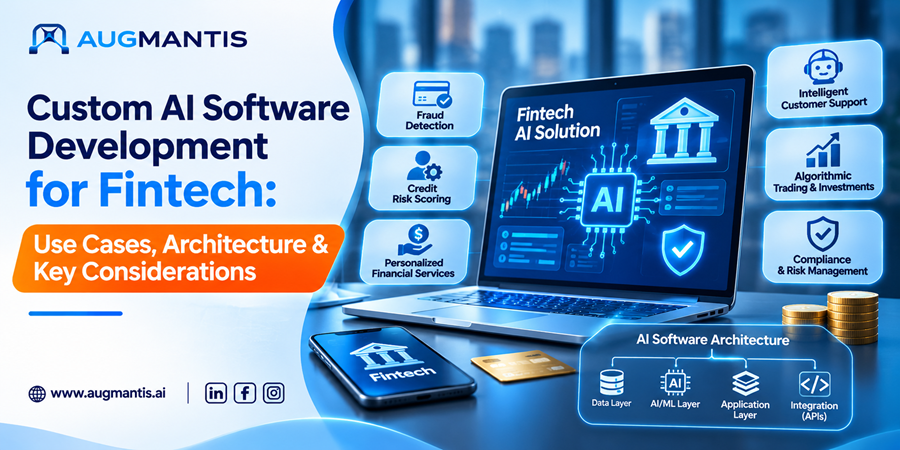
Financial services rely on data, speed, and trust. Whether it is paying with cards, approving a loan, or making any other decision, everything relies on the efficiency of interpreting information. That is why the application of AI in FinTech has transitioned from an optional tool to something that is inherent in the development of any product. However, out-of-the-box AI solutions rarely work well in the context of regulated transfer of funds. Only bespoke solutions will allow you to convert a great idea into a reliable competitive advantage.
This blog will guide you through some of the most useful applications of AI in FinTech, reference architecture, and factors that need to be considered while building your solution. Let’s take a look:
Why Customized AI Outshines Off-the-Shelf Solutions for the Finance Industry
Ready-made AI Platforms are appealing because they are quick to implement. When dealing with finances, however, quick deployment is often not the only criterion needed. There has to be an ability to ensure that a model is transparent, audit-proof, safe, and fine-tuned according to your proprietary transaction data. Generic fraud detection models trained using other people’s clients would not know the specificities of your user base, and generic chatbots would not comprehend your product requirements and disclosure rules.
For those who look into AI solutions for FinTech in USA, there are three main reasons why custom development is preferred:
- Distinctiveness: Your unique models trained with your own proprietary data will be difficult for your competitors to duplicate.
- Freedom: You can choose where data will be stored, how your models will be validated, and how explanations will be provided.
- Interoperability: Custom solutions will easily integrate with your banking, ledger, payments, and CRM stack.
High-Impact Fintech Use Cases for Custom AI
The most successful projects always begin with a well-defined business challenge and a well-measured result. This is where customized AI always brings value.
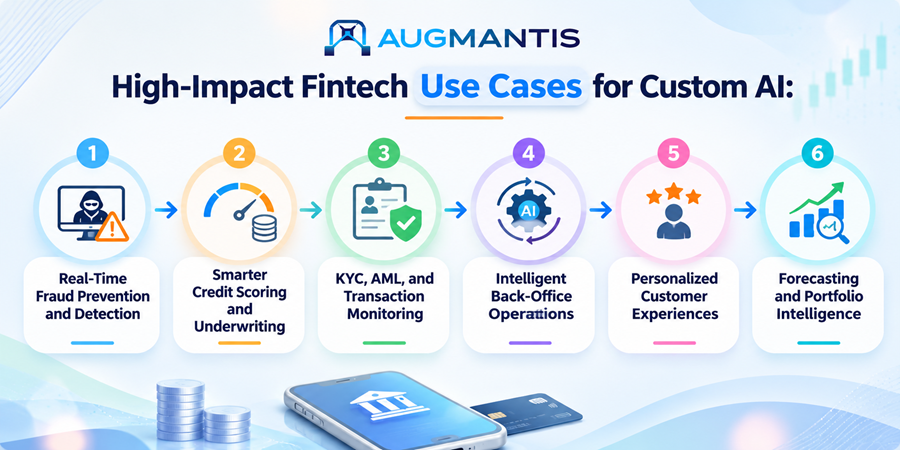
Real-Time Fraud Prevention and Detection
The machine learning algorithms can grade transactions in milliseconds, considering data from devices, user behavior, merchant history, and even networks. In contrast to rigid rules, which will be outdated after criminals find a workaround for them, the algorithms learn dynamically as new threats emerge. The graph algorithms help identify connections between people pretending to be legitimate customers.
Smarter Credit Scoring and Underwriting
Traditional scores are based only on a very limited view of the credit file. Custom scores could include cash flow information, payment history, and other factors to evaluate those who have thin credit files in a more accurate and fair way. The most important thing is the combination of prediction and explainability.
KYC, AML, and Transaction Monitoring
In addition, AI can obtain and validate information from the identity documents of individuals, compare names with those on watch lists without generating many false positives, and prioritize suspicious activity alerts. Eliminating false positives would be enough to save many hours for compliance officers.
Intelligent Back-Office Operations
These activities are repetitive and paper-intensive. AI automation for FinTech combines document processing, workflow orchestration, and language models to process routine transactions from start to finish, leaving any exceptions to be handled by humans. This means reduced operational costs and faster results for customers.
Personalized Customer Experiences
Personal recommendation engines, spending analysis, and conversational assistants assist users in budgeting, saving, and investing with personalized advice. Personalization based on approved product knowledge and the addition of guardrails ensures the accuracy of the responses.
Forecasting and Portfolio Intelligence
Time series and reinforcement learning methods help cash flow forecasts, liquidity management, risk exposure assessments, and portfolio reallocations to give finance managers early and well-informed alerts.
Reference Architecture for an AI-Ready Fintech Platform
A good design is the distinguishing factor between a proof of concept and a product. Successful FinTech software development ensures that AI becomes an integral architectural layer and not an additional feature. A basic architecture will have the following layers.
1. Data Ingestion and Storage
Streaming pipes such as Kafka streaming ingest transactions, events, and data from third parties in real-time mode, while the governed data lake/warehouse houses the historic data. The lineage of the data, its encryption, and access control have to be part of the design.
2. Feature Engineering and Feature Store
A centralized Feature Store ensures the consistency of features for training and inference purposes, avoiding minor inconsistencies that silently reduce the accuracy of models in production.
3. Model Development and Training
This includes experimentation, versioning, bias testing, and validation. Pipelines that are reproducible, along with a model registry, enable us to trace all decisions back to the particular model and data that generated those decisions.
4. Inference and Decisioning
APIs with low latency provide predictions for live applications, such as payments, whereas batch jobs perform scoring activities, including portfolio assessments. The decision engine will most likely integrate the models' output with business rules and threshold limits set by humans.
5. Monitoring, Governance, and Explainability
Data Drift Detection, Model Performance Monitoring, Fairness Metrics Evaluation, and Latency Monitoring are key functions of continuous monitoring. Explainability capabilities, along with audit logs, ensure that internal and external stakeholders are satisfied with the model.
6. Security and Infrastructure
Zero-trust network security, tokenization, secrets management, and identity controls help protect sensitive information. The cloud-native and containerized deployment ensures scalability when there are many transactions.
Key Considerations Before You Build
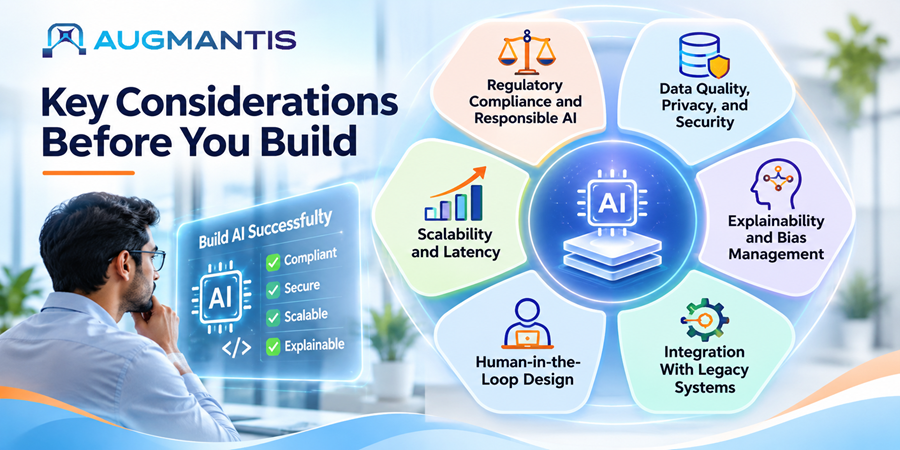
Regulatory Compliance and Responsible AI
US-based fintechs have to comply with regulations, including the Fair Credit Reporting Act, the Equal Credit Opportunity Act, and the Bank Secrecy Act. Additionally, there are various privacy regulations, including the CCPA, that need to be considered when implementing AI-Powered FinTech Solutions in the USA. There are also expectations from regulators about documenting, testing, and reviewing your models.
Data Quality, Privacy, and Security
Data is critical for having a great model. Ensure that your data is clean from the beginning, that customers have given their explicit permission, and that any personal information is stripped out wherever possible. Think PCI DSS and SOC 2 as the bare minimum.
Explainability and Bias Management
You can never defend what you cannot explain. Wherever possible, opt for simple models; where that is not feasible, apply methods such as SHAP and ensure fairness testing to make sure you do not have biased results.
Scalability and Latency
Responses for payment and fraud checks frequently require responses within 100 milliseconds. Prepare for maximum traffic and develop additional rules so that a model failure will not stop transactions.
Integration With Legacy Systems
Not all core systems support real-time AI functionality. Utilize APIs, streaming events, and incremental migration to update your systems while keeping the business running.
Human-in-the-Loop Design
Involve the people in important decisions. Give difficult or important cases to the analysts, and learn from their opinions to enhance the model.
Ready to Implement AI in Your Business?
From strategy to deployment, Augmantis helps you integrate AI into your workflows with scalable, future-ready solutions designed for real business growth.
Get Started with AI →A Practical Roadmap: From Idea to Production
- Define the business case: Select one use case with quantifiable benefits, such as reduced fraud losses or increased approvals.
- Assess data maturity: Evaluate data availability, data quality, and regulatory clearance.
- Implement the pilot: Deliver demonstrable benefits through a limited-scope project.
- Validation and documentation: Validate the model, perform bias testing, and undergo regulatory scrutiny.
- Launch with monitoring: Deploy in a staged fashion, starting with shadow mode or A/B testing.
- Iterate continuously: Refine, recalibrate, and scale based on changing data and regulations.
Teams that require additional engineering resources may rely on FinTech software development services in USA to speed up their development without compromising their architecture and security.
How to Choose the Right Development Partner
Technical skills aside, there are additional qualifications that will benefit you. Look for individuals or organizations with experience working in regulated financial settings, who understand how model risk management works, document things thoroughly, and are willing to teach what they know to your team. A reputable custom AI software development company will be able to give you examples of their work, talk about security and explainability, and offer measurable results.
Let’s wrap it up.
Custom-built AI allows fintechs to spot fraud quicker, underwrite with more equity, automate expensive processes, and delight customers, all the while remaining within compliance boundaries. Those who will succeed will be those who combine robust data infrastructure and strong architecture with effective governance. Start small, measure everything, and scale what works.
Also Read: Custom Fintech Software Development: Architecture, AI Integration, and Key Decisions
FAQs
1. What is custom software development for fintech with artificial intelligence?
This is a process that involves designing and implementing specific AI solutions that are designed specifically for a certain fintech company rather than applying general solutions. These solutions usually include a variety of applications such as a fraud engine, credit decision model, compliance application, and client assistant.
2. What are the most common use cases of fintech applications with AI?
These include real-time fraud detection, credit scoring, KYC and AML monitoring, process automation, personalization of the customer experience, and financial forecasting.
3. How much time does it take to build a custom AI solution for a fintech company?
A pilot project normally takes 8-16 weeks, while the development of the full-scale production solution with all necessary integrations, validation, and monitoring takes up to 6-12 months.
4. What measures can be implemented to ensure that AI models comply with US financial regulations?
Leverage a lifecycle-based compliance framework through documentation of data sources and model logic, validation of models by an independent party, testing of the model for any form of discrimination, explainability of decision-making, audit logging, and performance monitoring after deployment.
5. Is it better for a fintech company to develop AI in-house or outsource its development to an external company?
The main difference between in-house developers and external developers is time and speed versus control and specialization. Some organizations implement a hybrid strategy where the external party helps deliver the first release and then trains the in-house team.

Related Blogs