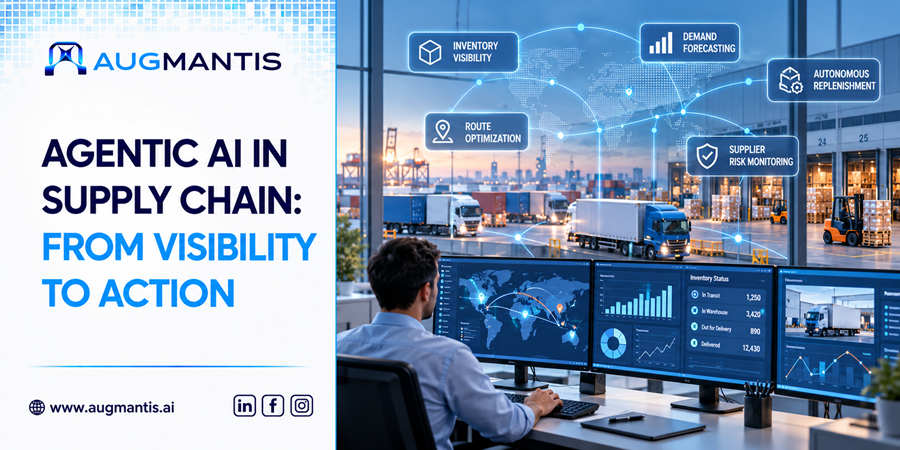
Despite the fact that even today's supply chain processes produce more data than everyone in the world can consume, most companies still operate reactively. This is when the dashboards bring attention to problems with delays, shortages, or a bad vendor, and people start solving the problem, getting approvals, and updating all systems manually.
Agentic AI was explicitly developed to solve this problem. Unlike traditional applications that analyze the data and suggest actions to take, Agentic AI sets a goal, makes decisions based on certain constraints, and takes actions through all systems. In fact, this functionality defines a paradigm shift in the usage of artificial intelligence in supply chains from mere information about past events to actions.
In this blog, we will discuss what agentic AI is, why it is needed in supply chains, what benefits it provides, what challenges can be encountered, and where to start.
What Is Agentic AI in Supply Chain Management?
Agentic AI refers to an AI system made up of several independent components known as "agents." Such an agent is given a task that could be to ensure a certain service level, minimize the cost of freight, and prevent stock-outs. It then establishes how to achieve its objectives by using the data at its disposal and reaching conclusions about the results.
Regarding the supply chain management scenario, different agents can undertake different duties. Some will monitor deliveries, others will manage inventory, and some will interact with suppliers. Generally, they will help in making connections between different functional domains. The rising popularity of agentic AI development services in the USA suggests that there is a need for AI systems that go beyond offering insights.
Key Characteristics of Agentic Supply Chain Systems
- Goal-oriented: they act on goals like reducing costs, accelerating things, or increasing sustainability instead of merely adhering to rules.
- Independent action with limitations: they act independently within the limitations and approval thresholds that you set for them.
- Adaptable: they modify their plan based on changes in the scenario, like at the port or a sudden increase in demand.
- Comprehensive: they include all aspects of ERPs, warehousing, logistics, and suppliers and are not limited to any particular solution.
- Continuous improvement: each experience improves the decision-making process in the future.
How Is It Different from Traditional Automation and Generative AI?
Automation operates according to predetermined if-then logic until something unpredictable happens. Generative AI is capable of summarizing information and writing an email, but it usually does that in response to a human instruction. Agentic AI, on the other hand, is a combination of reasoning and action, since it can evaluate possibilities, make a decision, and implement that decision.
In order to understand why this distinction matters now, it is important to consider the strain on the supply chain industry.
Why Supply Chains Need Agentic AI?
Supply chains have become more complicated and unpredictable in the modern era than ever before. The customer is demanding speed and accuracy. Suppliers, ports, and carriers might suddenly change their plans. Prices of logistics services, labor, and raw materials are changing all the time. Visibility solutions allow teams to see such changes; however, seeing is not everything.
The rest of the process planning and action still takes too much time and is done manually. A planner might spend several hours comparing different carriers, checking stock at different facilities, and exchanging emails to solve one issue, while there are many more issues waiting to be addressed. This is why more and more organizations start considering the use of AI solutions for supply chains.
How Agentic AI Moves from Visibility to Action?
The AI systems that have been developed in logistics all use the same cycle, and every step is a build-up from the last.
- Sensing: The agent continuously collects data from ERP, transport, and logistics systems, supplier portals, weather reports, and markets to determine the changes in the process.
- Decision-making: The agent makes decisions regarding the alternatives available, such as new routes, carriers, or suppliers, based on costs, risks, and service effects.
- Execution: It carries out the chosen actions, such as freight booking, moving inventories from one warehouse to another, or placing orders either automatically or with human consent.
- Learning: The outcome is then sent back for learning in order to make quick and accurate decisions in the future.
A Simple Example: Before and After
Let's consider that one of the suppliers notifies you that an important part will be delivered five days late. In case there was no agentic AI, then the planner should go through all open orders, call the supplier, search for an alternative vendor, and notify all customers, which may take the whole day. However, if we have an agentic AI, then the AI agent immediately detects the problem after logging it, calculates affected orders, receives quotes from alternative vendors, selects the optimal variant, and writes messages to the customers. The planner verifies the actions performed by the AI and confirms them.
The same scheme can be used in various aspects of the supply chain, and this brings us to the real application scenarios.
Key Use Cases of Agentic AI Across the Supply Chain
From planning to last-mile delivery, agentic AI can help in almost all phases. This is the reason why artificial intelligence in logistics is one of the hottest fields of AI investment.
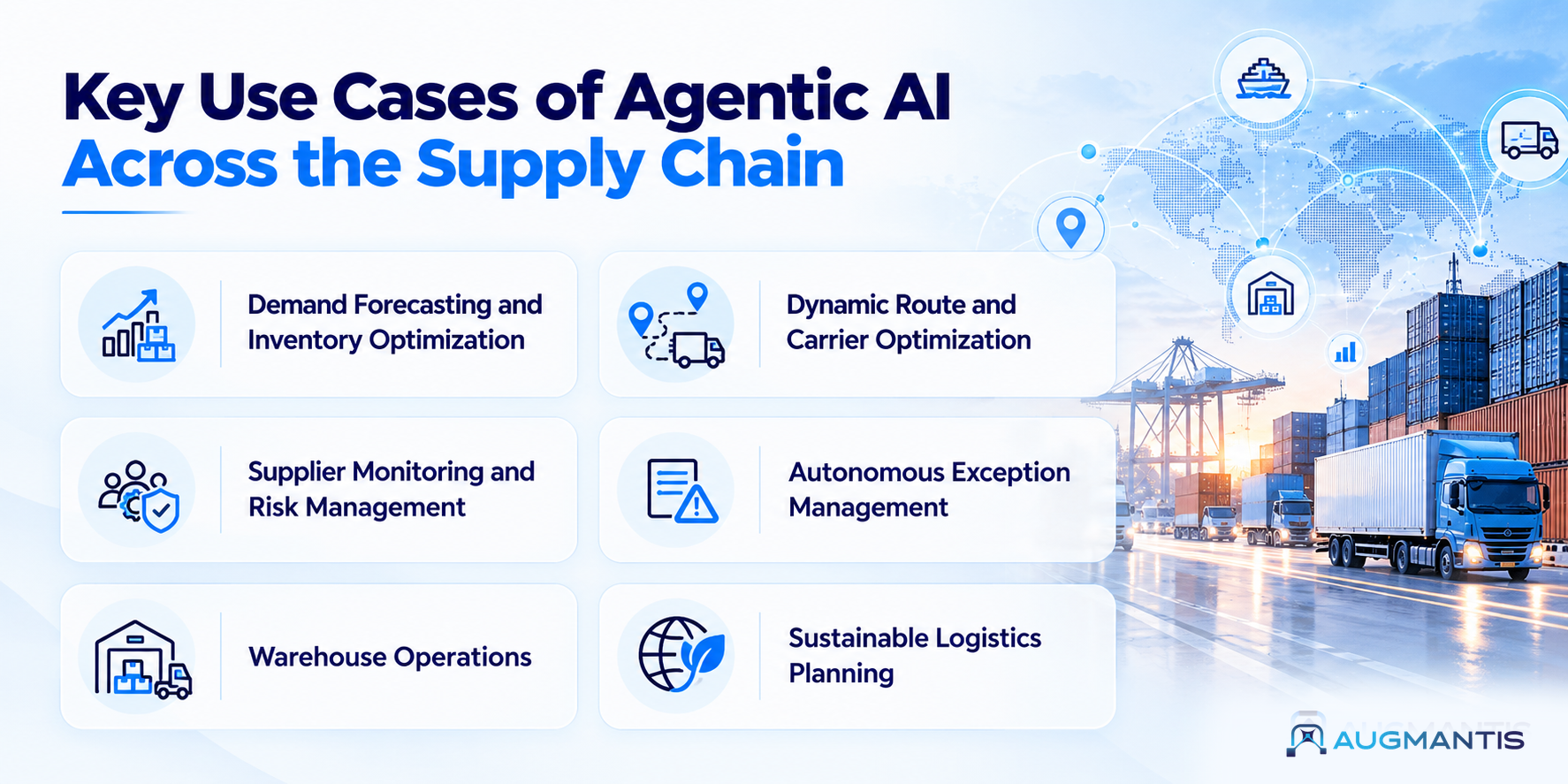
Demand Forecasting and Inventory Optimization
Agents leverage past sales data, promotions, seasonal factors, and external inputs to optimize their forecasts. They will thus be able to reposition inventory and initiate replenishment before stocks run out, without overstocking.
Dynamic Route and Carrier Optimization
The agents use live information for traffic, weather conditions, and dock conditions in route planning and select the carriers on the basis of cost and dependability.
Supplier Monitoring and Risk Management
Agents monitor the delivery process, product quality, and financial stability of suppliers, and they look out for any news that might lead to disruptions. In case of an increase in risk, alternative sources may be proposed or initiated.
Autonomous Exception Management
Late deliveries, defective products, lost documentation, and order modifications are typical exceptions. The agents deal with the simple ones in their entirety and refer only the complicated ones to people after collecting all information about them.
Warehouse Operations
Agents will be used to coordinate the movement of people, storage facilities, and orders, depending on changes in priorities as the shift progresses.
Sustainable Logistics Planning
Through consideration of emissions, cost, and time, the agents can facilitate route optimization, improve planning of loads, and reduce empty mileage.
The importance of such applications is reflected through business outcomes.
Business Benefits of Agentic AI
For enterprises facing changes in tariff, shortage of labor, increased cost of transportation, and fast delivery by customers, AI-enabled supply chain solutions in the USA have begun to be seen not just as pilots but also as an important part of business. These supply chain solutions provide the following benefits:
- Faster decision-making: response time is reduced from days/hours to minutes.
- More cost savings: fewer rush shipments, less overstock, and less manual labor.
- Increased flexibility: early identification and alternative actions to buffer any disruption.
- Visibility throughout the chain: agents tie together data that used to be kept in separate silos.
- Higher customer satisfaction: deliveries made on schedule and warnings regarding any problem.
- Scalability: fewer agents are needed to handle more orders as the number of orders grows.
Agentic AI and People: A Partnership, Not a Replacement
The fear that AI-powered supply chain solutions in the USA may lead to the replacement of supply chain experts has often been expressed. In reality, the use of an agentic AI should be regarded as a kind of copilot. It is responsible for the tedious work of monitoring and coordinating processes, while humans set the targets and establish the criteria and also make the critical decisions.
Nonetheless, the success of a rollout will also involve preparing for certain difficulties.
Challenges to Plan For
- Data quality and availability: agents depend on high-quality and integrated data; therefore, poor quality and lack of integration of information can hinder their performance.
- Integration with legacy systems: old ERP systems and legacy systems for transport should be integrated properly.
- Governance and trust: regulations and limits on approvals ensure transparency in decision-making processes.
- Security and compliance: agents require controlled access to confidential data about suppliers and customers.
- Change management: employees should receive training in order to know their future role.
These problems can be addressed more easily by an established AI development company.
How to Choose the Right Development Partner?
Building an agent-based solution calls for more than a well-built model. There is a need for expertise in various fields such as AI engineering, data integration, security, and logistics. Partnering with an AI development company will certainly reduce your time and risk.
Ready to Implement AI in Your Business?
From strategy to deployment, Augmantis helps you integrate AI into your workflows with scalable, future-ready solutions designed for real business growth.
Get Started with AI →While evaluating potential partners, one needs to consider the following:
- Experience in supply chain and logistics applications of AI, and not just generic AI.
- Data engineering and system integration experience.
- Security, compliance, and governance aspects.
- Phased approach to demonstrate value before scaling.
If your procedures, transporters, and approval processes have proprietary attributes, custom AI agent development services are likely more suited than any out-of-the-box solutions because the agents will fit into your operations model.
A Practical Roadmap to Get Started
- Choose one particular challenge, for example, delayed delivery, shortage of stock, or supplier delays.
- Find out what you have in your data, what is inconsistent, and what you lack.
- Carry out a selective test trial with people responsible for action approval and with measures of savings in hours or money.
- Go about it systematically, by increasing the number of agents and their independence, as success leads to confidence.
- Keep on reviewing and revising your guidelines as your business environment changes.
Final Takeaway
Information has always existed in supply chains, but what has been missing is the ability to act on that information in a timely manner. That’s where agentic AI comes in, as it senses, assesses, and acts with boundaries set, while leaving human beings in charge of those things that are truly important. Whether you’re beginning your journey with artificial intelligence in supply chain or building upon an existing solution, the surest route to success would be with a single, well-articulated use case.
If you’re ready to progress beyond visibility to action, collaborating with experts in agentic AI development services in the USA can make that happen for you.
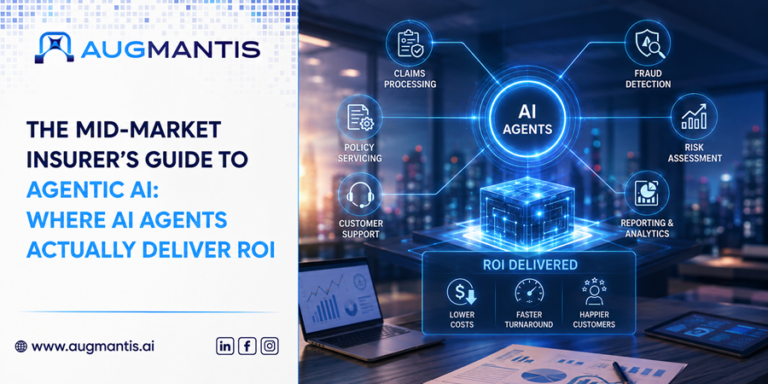
Also Read: The Mid-Market Insurer’s Guide to Agentic AI: Where AI Agents Actually Deliver ROI
FAQs
1. Explain agentic AI in supply chain management.
Agentic AI in supply chain management uses autonomous software agents that observe data, make decisions, and take actions like rerouting shipments and restocking, based on the rules established by the company. In contrast with conventional analytics, these agents not only identify the problem but actually help solve it.
2. How does agentic AI differ from conventional supply chain automation?
Conventional automation operates under set guidelines and cannot cope with unforeseen circumstances. Agentic AI, on the other hand, analyzes the situation, evaluates choices, and changes its course of action.
3. What are some of the major advantages of AI-powered supply chain solutions in the USA?
Usually, businesses get a quicker decision-making process, reduced costs of logistics and inventory, protection from disruptions, and on-time deliveries. Additionally, AI-powered supply chain solutions in the USA allow employees to concentrate on strategic operations.
4. Should the firm develop customized AI agents or use off-the-shelf solutions?
Off-the-shelf solutions are best for routine or standardized tasks. If the firm's processes/systems or its supply chain network is unique, then the services of customized AI agents will be more appropriate.
5. How should a company begin the journey of agentic AI in logistics?
It should choose one specific problem, say delivery delays, verify its data and work with an experienced AI Development Company for running a pilot project and scaling up.

Related Blogs