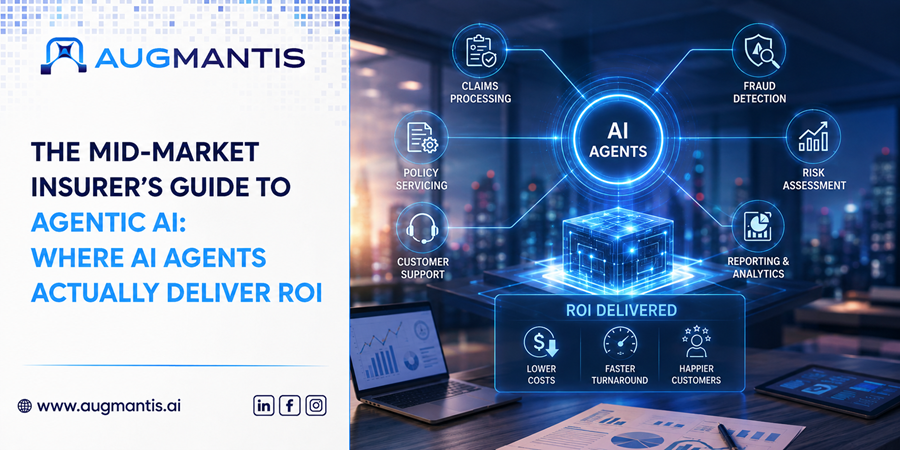
Medium-sized insurance companies are increasingly being forced to increase speed and efficiency while providing a better customer service experience without creating big tech teams like their big competitors do. This is where AI Solutions for Insurance become more relevant. And the main challenge is not limited to just applying AI for data analysis or performing one task at once. It lies in implementing AI agents that are able to comprehend the task, interact with other systems, make decisions according to some rules, and perform workflows.
Why Agentic AI Matters for Mid-Market Insurers?
Automation of this kind has been useful to insurers for quite some time now. Workflows that are rules-based can facilitate transfer of data between different systems, issue notifications, and initiate pre-specified actions. Nonetheless, the operations within the industry hardly remain static at all times. For example, claims come without relevant data, underwriting applications might have unstructured documents, and customer service requests might need information from various different systems.
This is where AI in Insurance has gone beyond simple automation. Agentic systems can make sense of the information provided, figure out the actions to be taken next, perform actions using pre-approved tools/systems, and even escalate exceptions in case human intervention is necessary. Rather than automating a single action, insurers can automate parts of an entire workflow.
What Makes an AI Agent Different From Traditional Automation?
A particular AI agent is built to perform towards a specific goal but not to perform based on some static command. The AI agent is able to intake information, understand the context, make choices on available actions, engage with the integrated tools, and react to changes in the process flow.
The power of AI Agents for Insurance lies in this ability to control interconnected processes. Nevertheless, the agents require some restrictions. Effective insurance AI applications are not just granted unlimited access and told to "process claims."
The Basic Anatomy of an Insurance AI Agent
Most enterprise-grade AI agents have several important capabilities:
- Thinking and planning. Deciding what to do next
- Access to tools to get information or do approved tasks.
- Orchestration of workflows for multi-step sequencing
- Memory or context management to remember relevant case information
- Human escalation for exceptions or high-risk decisions”
- Governance and continuous improvements monitoring and logging
The best implementations are those that combine the flexibility of AI with the controls insurers already require.
Where Mid-Market Insurers Actually See ROI?
Agentic AI may come across as an overly ambitious concept, but its ROI will most often be found in real-world operations issues. The right way to approach it is through high-volume, repetitive, manual tasks involving multiple systems and delays.
An effective solution will not be required to revolutionize the company right away. In most instances, a limited scope task may add value while building up internal trust in the AI within the insurer’s environment.
Claims Intake and First Notice of Loss
Claim intake can be one of the most robust early use cases for Agentic AI in insurance claims. The claims agent can harvest data from emails, forms, uploaded documents, chats, or any other approved communication channel and structure this data into the correct claim format.
The claims agent can identify missing data fields, ask for more data, categorize the claim type, verify basic data points, and process the claim to the next step in the process.
Measuring ROI is relatively easy. Insurance companies can measure:
- Less manual entry of data
- Quicker claim establishment
- Less time spent on routine intake
- Incomplete claims files reduced
- Faster response times to policyholders
This means human teams can dedicate more time to complex cases than to administrative intake.
Claims Triage and Intelligent Routing
Not all claims require the same scrutiny. Some will simply pass through the process while others will require more scrutiny, expertise, and urgency.
The AI agent is capable of examining the information related to the claim and coming up with the best course of action. This involves classifying the nature of the claim, determining its complexity, identifying missing information, and assigning it to the right queue or expert.
Underwriting Submission Preparation
- Underwriters often waste precious time sifting through emails, applications, spreadsheets, PDFs, inspection reports, and other documentation prior to being able to analyze risk.
- The AI agent is able to gather all this data, extract important information, spot any missing information, check the consistency of information between documents, and summarize the whole package in an organized manner.
- For the medium-sized insurer, this would help increase the efficiency of the underwriting process without having to completely overhaul their underwriting system.
- The agent acts as an operations helper who prepares the case for the underwriter, who then has to make the important decision.
Enterprise AI Agents Need Clear Operational Boundaries
The term Enterprise AI agents can create the impression that an agent should independently run entire departments. In practice, the most useful enterprise deployments are usually more disciplined.
Insurance organizations need to define what the agent can access, what actions it can take, and when it must stop and request human review.
For example, an agent may be allowed to:
- Read claim documents
- Retrieve policy information
- Draft customer communications
- Create follow-up tasks
- Update approved system fields
- Route cases based on defined criteria
At the same time, the agent may be prohibited from making certain financial or coverage decisions without human approval.
These boundaries are not a limitation of agentic AI. They are a major part of making it useful in a regulated environment.
Why Customization Matters More Than Generic AI Tools?
Insurance processes revolve around specific products, policies, processes, data models, and systems. While a generic chatbot can answer questions, it won't necessarily know how a specific insurance company manages its claims or underwriting submissions.
That is precisely why Custom AI agent development services can prove useful if a firm requires its agents to operate in the existing environment.
Customization would enable the connection to approved systems, definition of organization-specific instructions, permissions, business rules, and workflows based on actual processes.
What matters is not the customization for the sake of customization. What matters is the customization that relates to what actually impacts business.
Choosing the Right Technology Partner
Collaboration with a professional AI agent development company in the USA can assist insurance companies in transitioning from piloting to production faster, especially where internal teams lack experience in AI agent orchestration, language models, data infrastructure, and AI governance.
Nevertheless, insurance firms must assess their prospective partners beyond the impressive demonstration. The considerations may include:
Ready to Implement AI in Your Business?
From strategy to deployment, Augmantis helps you integrate AI into your workflows with scalable, future-ready solutions designed for real business growth.
Get Started with AI →- Can the solution integrate with existing insurance systems?
- How are agent actions controlled and logged?
- What happens when the AI is uncertain?
- How is sensitive data handled?
- Can the workflow be adjusted as business requirements change?
- How will performance and ROI be measured?
Building the Right Data and Integration Foundation
An AI agent is as effective as the information and means at its disposal. If an AI agent cannot access pertinent information such as policy information, claims information, customer information, and documents safely, then its ability to accomplish tasks will be constrained.
This is where wider-ranging AI Development Services in USA can help in implementing the solution. This could require API Integration, data preparation, document processing, retrieval capabilities, workflow orchestration, monitoring, and security.
It does not necessarily require a mid-market insurer to build its complete tech stack from scratch in order for AI agents to be implemented. More often than not, they can be implemented via integration of certain aspects of an insurer’s systems.
It just takes starting with the workflow and working backwards from there.
Common Mistakes That Delay ROI
Agentic AI initiatives might fail to add any value for companies that pay too much attention to technology and not enough to the business problem itself.
Beginning With the Model Rather Than the Process
Instead of asking the question, “What kind of AI model do we need?” one should ask, “Where is there a business process causing measurable friction?”
After identifying the business problem, the company will be able to tell if the solution requires an AI agent or not.
Giving the Agent Too Much Responsibility
The process of autonomy needs to take place slowly and incrementally. The agent may start by making recommendations on actions and then perform low-risk actions once its performance is verified.
This will help insurers gain confidence and remain in control.
Ignoring Existing Employees
Employees are likely to have a better understanding of the workflow exceptions and bottlenecks compared to any other individuals. Engaging the claims teams, underwriters, and operations employees in the design phase will uncover issues that cannot be seen from a process flowchart.
The best AI agents are designed with actual work in mind and not the ideal process.
A Practical Roadmap for Mid-Market Insurers
A phased approach can reduce risk and improve the likelihood of measurable returns.
Phase 1: Identify the Right Use Case
Select a workflow with clear operational pain, sufficient volume, and measurable outcomes.
Phase 2: Map the Existing Process
Document where information enters the process, which systems are involved, where employees spend time, and where exceptions occur.
Phase 3: Define Agent Boundaries
Determine what the agent can read, what actions it can take, and which situations require human approval.
Phase 4: Launch a Focused Pilot
Start with a limited group, product line, or workflow rather than deploying the agent across the organization immediately.
Phase 5: Measure and Improve
Track handling time, accuracy, exception rates, employee feedback, and other agreed metrics.
Phase 6: Scale What Works
Once the insurer has evidence of value, the same architecture can often support additional workflows.
This approach gives leadership a clearer view of where agentic AI is producing genuine operational results.
Conclusion: Start Where the Business Can Prove Value
Agentic AI need not necessarily be introduced through an all-encompassing transformation initiative. Insurance companies in the mid-market can just focus on a particular workflow, put in place proper guardrails, measure its performance, and then scale up.
The best Custom AI Solutions for Businesses are those that address real-world operational issues as opposed to technical issues. Given the correct strategy, we at Augmantis are in a position to work with insurers to find out where AI agents can add value.
FAQs
1. What are AI Solutions for Insurance?
AI Solutions for Insurance employ AI techniques like machine learning, generative AI, document intelligence, and AI agents to make changes in areas including claims, underwriting, customer service, fraud detection, and operations.
2. How do AI Agents for Insurance improve operational efficiency?
AI Agents for Insurance could perform tasks such as retrieving information, reviewing documents, intake of claims, validating data, performing follow-ups, and routing the workflow.
3. What is Agentic AI for insurance claims?
Agentic AI for claims processing is AI that is capable of handling multi-task claims workflows within specified limits. This could mean the agent collecting claim data, spotting document requirements, looking up policy information, creating assignments, and submitting the claim to a human being where necessary.
4. Do mid-market insurers need Custom AI agent development services?
Custom AI development services for agents may be useful when an insurance company wants their AI agents to interact with their own policies, claims management, business rules, and other processes.
5. How should insurers measure ROI from AI in Insurance?
The ROI on using AI in insurance companies may be gauged through parameters like decreased time to handle, low cost to process, increased ability of employees, low error rate, quick responses, and effective workflow completion rate.

Related Blogs