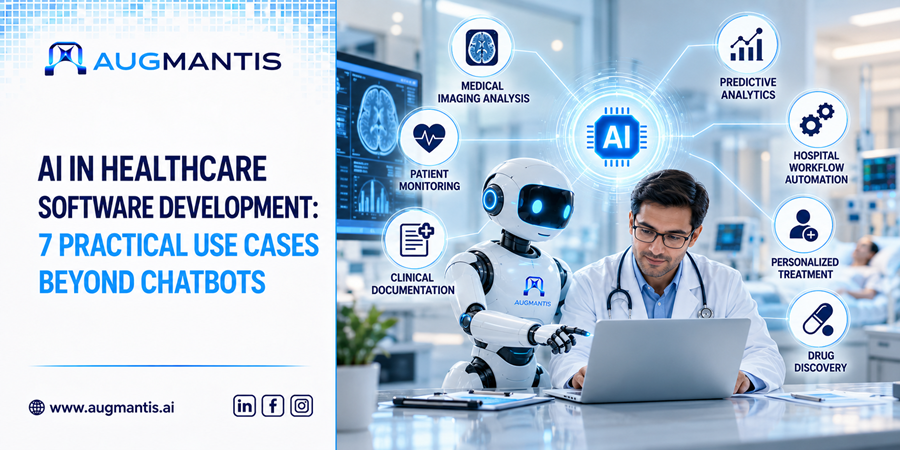
AI is changing the way that the healthcare industry is handling patient information, decision-making processes, and internal processes. Although the chatbot is commonly mentioned, AI in healthcare is not limited to it and includes the use of AI in medical imaging, predictive analytics, clinical documentation, remote patient monitoring, and hospital management.
Furthermore, hospitals produce vast amounts of data through EHRs, diagnostic reports, and connected medical devices. If used wisely, AI solutions for healthcare will allow professionals to uncover patterns, eliminate the need for routine work, and make better decisions.
More and more attention is paid to practical solutions rather than to theoretical possibilities of the application of AI in healthcare. In this blog, we will discuss seven cases of AI in healthcare software development besides the chatbot one.
Why Is AI Important in Healthcare Software Development?
The traditional models of healthcare utilize the storage and processing of information, but the recognition of patterns in big data is not easy. AI includes machine learning, natural language processing, computer vision, and predictive analytics.
Companies that have invested in healthcare AI solutions in the USA are researching these techniques to benefit from them in their clinical processes, operational planning, and patient data management. However, for them to be successful, there is a need to consider certain issues such as privacy, interoperability, regulation, and clinical governance.
The aim is to determine areas where AI can be valuable.
7 Practical Use Cases of AI in Healthcare Software Development
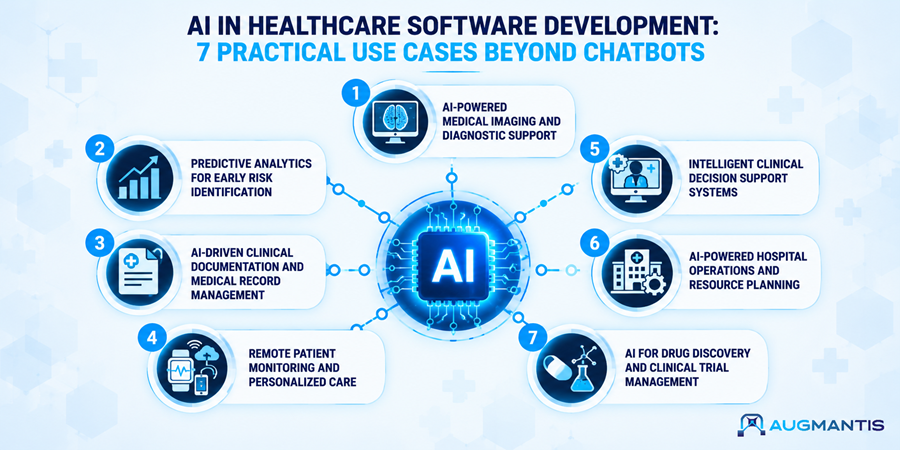
1. AI-Powered Medical Imaging and Diagnostic Support
The AI-driven imaging technology is used to analyze X-rays, CT scans, MRIs, and other types of imaging data using machine vision and deep learning.
For instance, the radiology platform that incorporates AI can detect potential lung abnormalities on a chest X-ray, which will then be further evaluated by a radiologist. AI-powered healthcare solutions are able to provide such functionality in terms of medical imaging analysis.
Key benefits:
- Aids in detection of important imaging findings.
- Helps in prioritizing urgent cases.
- Reduces repetitive imaging review.
- Ensures consistency if the models are validated.
Artificial Intelligence can help in the process of diagnosis but will not take the place of clinical assessment. These models have to be tested for their intended application.
2. Predictive Analytics for Early Risk Identification
Predictive analytics helps healthcare professionals recognize patients who are at risk of experiencing complications, readmissions, or further deterioration. Artificial intelligence uses data from medical history, lab results, and vital signs to detect any patterns that need to be paid attention to.
The use of AI software development for healthcare can help incorporate predictive models into the clinical dashboard where risks can be detected. For instance, a healthcare facility may notice alarming vital signs and notify the clinical team of such findings.
Key benefits:
- Enables earlier identification of possible health risks.
- Helps in prioritizing patient follow-ups.
- Gives more information for planning care.
- Aids in better resource allocation.
The predictive models must be tested for accuracy, errors, and biases. The outputs from such models should guide, but not decide, the treatment process.
3. AI-Driven Clinical Documentation and Medical Record Management
Clinical Documentation requires a lot of time, from note-taking to maintaining patient history and medical record generation. AI could facilitate the process through speech-to-text transcription, document summarization, and information extraction.
For instance, an AI-powered EHR solution would help generate a draft summary of the consultation, which the clinician would later need to review and validate.
Modern medical software solutions in the USA would have these features available to reduce paperwork and organize the clinical information as well.
Key benefits:
- Eliminates redundant documentation.
- Ensures efficient management of patient information.
- Provides access to clinical information.
- Ensures standardized documentation.
Human verification is necessary to avoid mistakes and ensure accuracy of medical records.
4. Remote Patient Monitoring and Personalized Care
With remote patient monitoring technology, healthcare professionals are able to monitor selected health parameters from outside clinical environments. Using AI, data collected by connected devices such as blood pressure machines, glucose monitoring equipment, and wearable technology is reviewed to check for any anomalies.
This means that where there is an observable trend with respect to a patient's readings, a notification may be sent to the care team for analysis. Integrating AI solutions for healthcare into the remote monitoring process will make it possible to assess patients' progress between visits.
Key benefits:
- Enables the monitoring of patients between visits.
- Can detect possible warning signs of health problems.
- Increases access to patient information over an extended period.
- Fosters better decisions regarding follow-up care.
The successful deployment of this technology depends on reliable integration, appropriate thresholds, and effective escalation procedures.
5. Intelligent Clinical Decision Support Systems
The clinical decision support systems assist healthcare providers in considering all relevant data while diagnosing and making treatment decisions. AI may be used to analyze the patient’s history, laboratory results, drug data, and clinical guidelines.
Ready to Implement AI in Your Business?
From strategy to deployment, Augmantis helps you integrate AI into your workflows with scalable, future-ready solutions designed for real business growth.
Get Started with AI →An example of how AI can be used here is to provide alerts about possible interactions or display related clinical guidelines for consideration by a doctor.
With the right design, the AI-powered healthcare solution will make it easier for the clinician to get the information without having to go through different systems.
Key benefits:
- Supports the medication safety check process.
- Increases accessibility of relevant information regarding patients.
- Finds useful clinical guidelines.
- Saves time on searching.
AI suggestions must be reviewed by the professionals, who will have the final decision-making responsibility.
6. AI-Powered Hospital Operations and Resource Planning
Coordination between staff members, beds, scheduling, inventory, and admission of patients is required for hospitals. AI can make analyses based on historical data to provide help with planning resources.
For instance, a management system for a hospital can foresee times when the demand for admission will be high, which helps managers schedule the work and beds accordingly. This can be done by organizations looking into healthcare AI solutions in the USA.
Key benefits:
- Contributes to effective resource planning.
- Facilitates prediction of patient demand.
- Enhances visibility.
- Saves time on planning.
Forecasting should be reviewed regularly since unpredictable situations may not necessarily follow past trends.
7. AI for Drug Discovery and Clinical Trial Management
AI can help the process of pharmaceutical research in such a way that it analyzes biological data, finds out promising drug compounds, and helps researchers to prioritize certain compounds for further studies.
Clinical trial management can be assisted by AI in analyzing research documents, checking eligibility criteria, planning the recruitment process, and tracking progress. With the help of AI software development for healthcare, this process can be integrated into research platforms.
Key benefits:
- Facilitates analysis of scientific data sets.
- Aids in prioritizing drug candidates.
- Assists in reviewing clinical trial documents.
- Increases transparency around recruitment and the progress of trials.
Scientific verification of AI discoveries is still required. Laboratory testing, clinical trials, and regulatory approval processes will continue to be necessary in order to verify the safety and efficacy of new drugs.
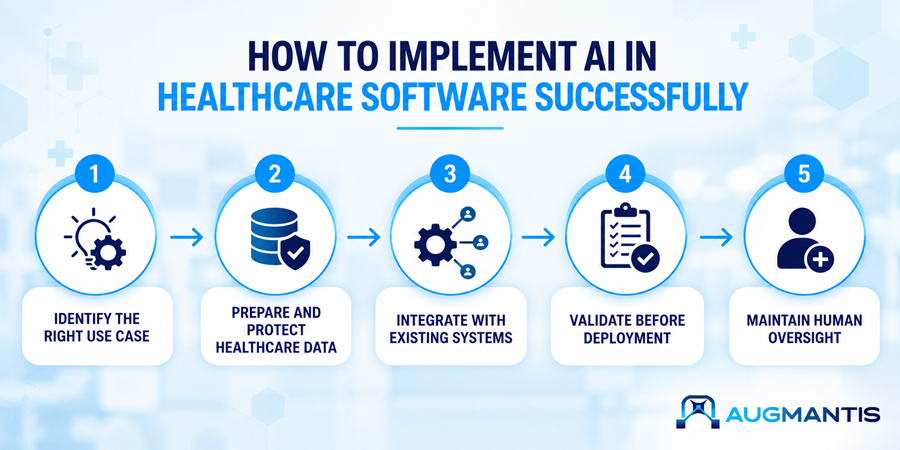
How to Implement AI in Healthcare Software Successfully?
The successful implementation involves more than the selection of an AI model. It is important for companies to make sure that the technology tackles real issues.
Identify the Right Use Case
Identify a quantifiable problem like a long documentation process, ineffective patient follow-up procedures, or slow review of diagnostic information. Specify success criteria before choosing the technology.
Prepare and Protect Healthcare Data
Data quality issues, missing data, and contradictions need to be analyzed. Proper security needs to be provided to protect patient data.
Integrate With Existing Systems
Make sure that the solution is interoperable with the relevant EHR, lab, medical device, and hospital management software. Interoperability is useful in reducing fragmented workflows and manual data entry.
Validate Before Deployment
Test the test for accuracy, reliability, and limitations by applying it to real-life situations. Have the healthcare practitioners assess the test to determine its appropriateness for use.
Maintain Human Oversight
State the conditions under which the task could be automated using AI technology and the conditions that require the professional’s approval.
The above-stated steps will help healthcare organizations create reliable AI solutions for healthcare that meet real-world needs.
Challenges to Consider When Adopting AI in Healthcare
Despite all the opportunities that AI provides, there are some issues that healthcare organizations need to resolve when implementing such solutions.
- Data security and confidentiality: Secure sensitive patient data with proper protection measures.
- Data completeness and bias: Consider whether the datasets used are complete and unbiased.
- System integration: Make sure that the technology integrates well with other healthcare applications.
- Clinical validity and error management: Validate results and set an error management process.
- Regulatory compliance: Determine the necessary privacy laws and medical device regulations.
- User acceptance: Provide user training and make sure the solution fits your processes.
Dealing with these issues is important for developing safe medical software solutions in the USA.
Let’s wrap it up.
AI is pushing healthcare software further into the realm of more than just chatbots and automation. With examples from areas like medical imaging, predictive analysis, remote patient monitoring, hospital management, and drug development, each could play a role in helping healthcare providers handle their information and streamline their processes.
Some of the best use cases have been where there is good data, proper system integration, clear goals, and clinical input. In moving forward, AI in healthcare must consider the practical applications and thoughtful development of software.
Also Read: AI in Healthcare: From Chatbots to Intelligent Workflows
FAQs
1. How is AI utilized in healthcare software development?
AI is mainly used for analyzing medical images, predictive modeling, documentation of clinical practice, monitoring of patients remotely, clinical decision-making support, planning hospital resources, and drug discovery. These technologies assist healthcare practitioners in analyzing data and optimizing particular processes.
2. How does AI enhance healthcare software?
AI can be utilized to automate tasks, recognize patterns in patient data, optimize clinical processes, and forecast the needs of healthcare providers. Its efficiency depends upon the quality of data and system integration.
3. Can AI aid in disease diagnosis by physicians?
Yes. AI is capable of identifying possible anomalies in medical imaging, as well as spotting trends in clinical data. It is important, however, that there is a professional interpretation of the findings.
4. Is healthcare software that uses AI safe for patient data?
AI solutions can include elements like encryption, access control, auditing, data governance, etc. Healthcare institutions are also required to meet certain privacy and security standards.
5. What do healthcare organizations need to take into account when implementing AI?
It is necessary to assess an organization’s goals, data quality, integration needs, costs, compliance requirements, models’ reliability, and user adoption. Human oversight and metrics are to be established prior to the implementation of AI-powered solutions.

Related Blogs