While there is continued growth in the digital transformation of the healthcare industry, it is only when one moves beyond mere record-keeping and automation that the real revolution takes place. The use of AI in healthcare is currently being done in areas like communication, documentation, decision-making, research, and administration within the industry. Using conversational interfaces and intelligent software, AI technology is helping manage information better within healthcare organizations.
How Is AI Changing Healthcare?
Artificial intelligence has the capability to analyze large amounts of structured or unstructured data associated with the healthcare sector and discover patterns and draw useful conclusions to make decisions repeatedly. Its use can range from booking appointments to patient engagement, from medical imaging to claims management, and from documentation to clinical decision support. AI solutions for healthcare bring all these together under one roof.
What makes the difference here is the fact that AI is no longer just used in individual use cases. The healthcare industry is gradually integrating AI functionality with its other systems such that data can flow across different workflows without the need for any human action at every step along the way.
From Automation to Intelligent Workflows
Standard systems for the automation of traditional health care normally function based on pre-defined rules. For instance, an automated system could schedule appointment reminders two days prior to the scheduled visit. Intelligent processes could take this further by analyzing information, understanding what needs to be done, and adjusting the next process.
For instance, an intelligent process could detect a missed appointment, analyze the mode of communication that would suit the patient, and then launch an appropriate communication process.
This does not imply that AI must make all healthcare decisions. There are cases in which the best approach to take would be to support the professionals in their decisions and provide necessary information to them.
Where Are AI Solutions Being Used in Healthcare?
AI solutions for healthcare can be useful in many areas in the healthcare domain, such as hospitals, clinics, diagnostics centers, pharma firms, insurance firms, and health tech firms.
Some applications include:
- Patient and member engagement
- Appointment scheduling and reminders
- Clinical documentation assistance
- Medical image analysis
- Revenue cycle management
- Claims and prior authorization workflows
- Patient triage support
- Healthcare data analysis
- Drug discovery and research
- Personalized patient communication
- Fraud and anomaly detection
- Healthcare operations and resource planning
The success of any AI application is contingent on its process. An AI application whose process has been narrowly defined, has reliable data, and involves proper human intervention might be more valuable than a generalized AI application.
What Are AI Agents in Healthcare?
AI agents for healthcare are programs that execute multi-step processes through AI models, tools, data sources, and predefined business rules. Unlike just producing an answer, an agent may be able to understand a request, get the necessary information, take an action, and send the results to further workflows.
Take the case of a referral management process. A healthcare agent can examine incoming referral details, find out missing documents, verify pre-defined conditions, request more information, and forward the ready referral to the right people.
More sophisticated structures may involve the use of several specific agents. One can deal with patient communication, another with data gathering from selected sources, and there can be a supervisory layer that would control the process flow. Such systems have to have proper access control, audit trails, and validation mechanisms.
Generative AI for Healthcare: Beyond Traditional Automation
Content creation and transformation through generative AI for healthcare includes the ability to generate summaries, draft communications, clinical documentation, knowledge answers, and other textual information.
For instance, a healthcare worker may employ generative AI to generate a summary of long documents prior to looking at the original document. A patient services team can employ generative AI to draft replies to frequently asked questions from an approved knowledge base.
Nevertheless, just because something is fluent does not necessarily mean that the output is correct. There must be a way for the generated content to be source-grounded, validated, secure, and monitored.
The Role of Healthcare Chatbots
One of the most noticeable uses of AI is that of healthcare chatbots. Such bots can offer patients a conversational interface for activities like information search, appointment verification, navigation, or education.
Current AI chatbot development services in USA could use NLP, retrieval technology, a healthcare knowledge base, authentication, and integration with current applications. However, the point is not to build a chatbot that can hold conversations but a managed one that will give necessary information without breaching confidentiality and other operational restrictions.
Moreover, a healthcare chatbot must clearly indicate its limitations. In case of clinical issues, the system might need to redirect a user to the appropriate specialist.
AI Chatbot Solutions and Patient Engagement
AI chatbot solutions can assist healthcare providers in delivering consistent replies to queries through websites, portals, and various other digital tools. These solutions can deliver a variety of replies based on their implementation, such as FAQs, scheduling appointments, navigation, educating patients, and admin tasks.
The best practices of implementing conversational AI involve using the interface with a trusted data source rather than relying solely on a language model. This can prevent delivering any kind of reply without sufficient evidence and allows organizations to update information regularly.
How AI Fits Into Medical Software?
Independent operation of healthcare AI is quite rare. Instead, AI technology usually needs to integrate with such health tech as electronic medical records, patient portals, appointment scheduling tools, laboratory information systems, billing applications, radiology information systems, and others.
Medical software solutions in the USA are more likely to incorporate AI functionality within their existing IT frameworks as opposed to implementing artificial intelligence as an entirely independent solution.
This means that interoperability becomes an important issue. Before large-scale deployment of AI, organizations have to analyze data formats, API integration, identity management, permissions, security measures, and more.
Building AI Software for Healthcare
AI software development for healthcare in the USA needs a totally different perspective compared to the development of AI software for consumers. Healthcare software needs to consider various aspects like privacy, security, regulation, data integrity, clinical processes, users, and accountability.
The development process may include:
- Workflow Identification: Identify the problem AI is supposed to solve.
- Assessment of Data: Ascertain whether the necessary data is present and is appropriate for use.
- Choice of AI Approach: Decide whether a predictive model, generative AI, retrieval-augmented methods, agents, or any other method is suitable.
- Design of Human Intervention: Design the points at which human professionals will have to intervene in the process.
- Secure Integration: Integrate the solution into the healthcare systems with access to relevant data.
- Extensive Testing: Test for accuracy, security, failure, biases, etc.
- Monitoring Post-Deployment: Monitor the performance of the solution and improve the solution over time.
Key Benefits of AI-Enabled Healthcare Workflows
AI offers multiple advantages that could come about through its deployment within clearly defined use cases.
Ready to Implement AI in Your Business?
From strategy to deployment, Augmantis helps you integrate AI into your workflows with scalable, future-ready solutions designed for real business growth.
Get Started with AI →Reduced Administrative Work
AI can help with the writing of repetitive documents, information search, communication, scheduling, and other administrative functions. This can minimize the effort that is needed for these functions.
Faster Access to Information
Often, healthcare practitioners are required to access information in various systems. AI-based document retrieval and summarization can assist in accessing information faster, as long as the underlying information is reliable and valid.
More Consistent Patient Communication
AI-powered communication systems can assist organizations in offering consistent responses to commonly asked questions while being available beyond standard office hours.
Workflow Coordination
Agent-based models can link different stages in the same process. They can facilitate the coordination of data collection, data verification, and follow-up actions, rather than just automating a single action.
Operational Insights
Through analysis of operational data, AI can be used by organizations to detect bottlenecks, make predictions on demand, spot unusual patterns, and improve workflow performance.
What Are the Challenges of AI in Healthcare?
However, using AI technology also raises some challenges that must be taken into account. Healthcare data might be fragmented, sensitive, incomplete, or hard to standardize. There is always a risk of generating incorrect results due to the use of inaccurate or misleading AI algorithms.
One should take into consideration the following issues:
- Data privacy and security
- Regulatory requirements
- Model accuracy and reliability
- Bias and fairness
- Explainability and traceability
- Human oversight
- Integration with existing systems
- User training and adoption
- Continuous monitoring
- Vendor and model dependency
What Does the Future of Healthcare AI Look Like?
The next wave of AI in healthcare will likely place greater emphasis on integrated workflows rather than tools alone. Chatbots could act as entry points to larger ecosystems of services, and AI agents for healthcare might manage selected administrative and operational processes.
Generative AI can also have more impact when applied together with reliable healthcare data, retrieval technologies, specific models, and workflow automation. At the same time, the human factor will stay essential in cases of processes that require clinical expertise and discretion.
The most realistic approach is not to substitute healthcare specialists with AI but to allow them to spend less time on routine actions and more on those that require professional expertise and personal interaction.
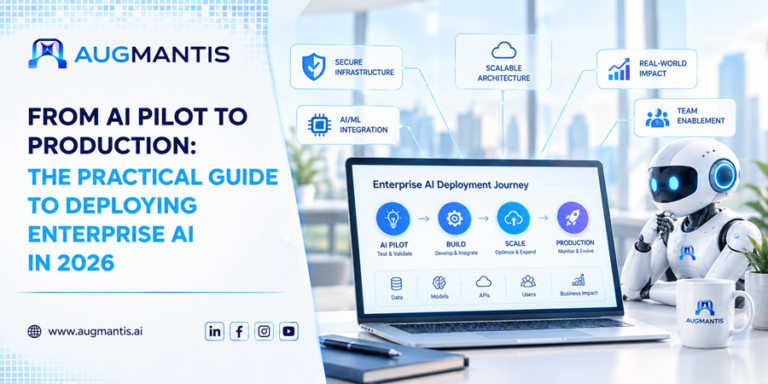
Also Read: From AI Pilot to Production: The Practical Guide to Deploying Enterprise AI in 2026
Frequently Asked Questions
1. What is AI in healthcare?
Artificial intelligence in healthcare is the application of artificial intelligence technology in analyzing healthcare data, automating processes, gaining insights, communicating, and helping with healthcare workflows. These include uses such as chatbots, medical imaging analysis, documentation, patient engagement, claims processing, and predictive analytics.
2. How do AI agents function in healthcare?
AI agents can complete multi-step activities by interpreting information, accessing authorized information, leveraging connected tools, and executing predefined activities. Uses in healthcare can include referral coordination, administrative assistance, patient communication, documentation workflow, and claim-related activities.
3. Can AI chatbots replace healthcare professionals?
Definitely not. Most healthcare chatbots work very well with particular administrative, informative, and engaging tasks. Chatbots should provide patients with all the information about their capabilities and redirect any questions or requests that require clinical evaluation to healthcare professionals.
4. Is it safe to implement generative AI in healthcare?
It is possible to apply generative AI to healthcare, but the safety of this technology will depend on implementation and design aspects. It is necessary to pay attention to certain considerations, including privacy, reliable models, ground truth, access control, the human-in-the-loop principle, monitoring, and others.
5. What processes in healthcare can be automated with AI?
There are processes like appointments, interactions with patients, documentation management, information searching, insurance claims processing, referral processing, data analysis, and other processes that can be supported by AI.

Related Blogs