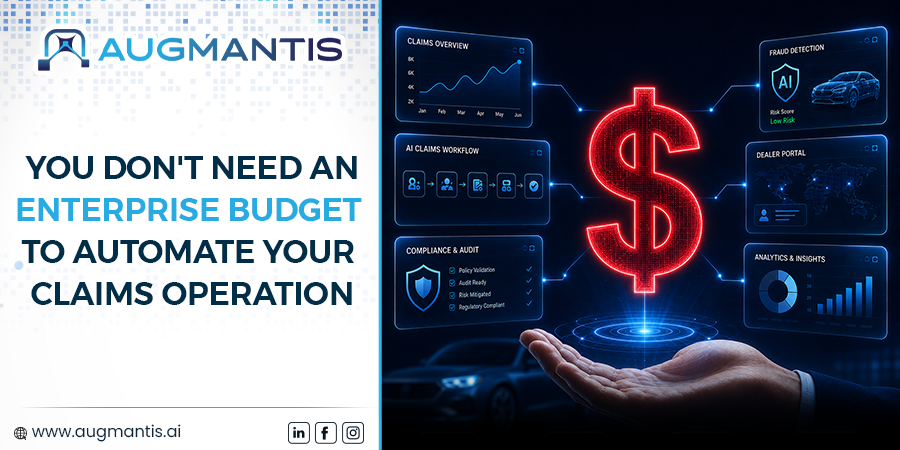
"Each delayed claim costs not only money; it costs the trust of your customer."
Claims processing is one of the most resource-intensive business processes that many insurance companies go through. This process includes manual document checks, tedious data entry, inaccurate claim evaluation, and lengthy claim settlement times. However, AI has already proved itself as a solution for the modernization of the claims process, but many insurance companies believe that small-scale insurance companies cannot accomplish automation, as they lack financial resources.
But this is no longer true.
Today, thanks to cloud AI, a modular approach to automation, and domain-specific machine learning models, insurance companies can automate their claims process regardless of the technology ecosystem they currently have.
It does not matter which is the most significant investment in AI; it matters which is the right one.
The following guide will explain how insurers can begin their AI transformation wisely, understand how to start with AI insurance company initiatives, evaluate organizational readiness, and implement scalable automation that expands alongside the business.
Why Claims Automation Is Not Only for Big Businesses Anymore
AI-powered claim management systems were previously available only to enterprise-sized insurance companies due to the high costs of infrastructure, the need for a team of data scientists, and the deployment of enterprise-class software. However, things have changed completely.
The latest AI-powered systems can be provided through a subscription model, can be easily integrated via API, have pre-trained language models for insurance claims management, and work on cloud-based infrastructure without any significant initial investment. Rather than building the entire claims management system, businesses can concentrate on automation of some specific processes.
This is why modern technologies make claims automation possible even for mid-sized businesses.
Instead of investing millions into a company-wide digitalization process, insurers can initiate small-scale automation projects, such as:
- First Notice of Loss (FNOL) processing
- Claim document classification
- Fraud risk detection
- Automated policy validation
- Claims summarization
- Intelligent customer communication
- AI-assisted adjuster recommendations
Each automation project delivers quantifiable operational improvements with low implementation risk.
Hidden Cost of Manual Claim Processing
Most insurance companies tend to overlook the impact that manual claim processing has on the overall business.
The claim process goes through various departments before getting settled. There are repeated verifications of the policies, document checking, customer communication, and updates in internal systems. All these lead to an increase in the time taken in processing the claims, along with chances of errors.
Some of the operational challenges are:
Long Claim Processing Times
Manual review leads to longer claim settlement times, resulting in lower customer satisfaction and more paperwork.
High Operating Costs
Big claims departments waste their precious time on routine administrative activities rather than working on more complicated cases that need human skills.
Inconsistency in Decision Making
Adjusters can come up with varying conclusions on similar claims, which negatively impacts compliance.
Lack of Scalability
During seasons of increased claims, manual processes cannot handle the high volume of work efficiently.
All these problems have a direct influence on profitability and do not depend on company size.
Why AI Should Be Implemented In Small and Mid-Market Insurance Companies
Small insurers are faced with bigger insurers that have more means than they do. The presence of automation ensures equality in the competitive landscape.
Instead of increasing staffing levels due to an increase in claims, AI improves what you already have by doing the mundane.
Some of the benefits include:
Ready to Implement AI in Your Business?
From strategy to deployment, Augmantis helps you integrate AI into your workflows with scalable, future-ready solutions designed for real business growth.
Get Started with AI →- Faster approvals of claims
- Reduced processing costs
- Greater customer satisfaction
- Improved fraud detection
- Consistent claim review
- Better adjuster productivity
- Better regulatory documentation
One of the ways through which an insurance AI startup company could succeed is by helping people in decision-making instead of replacing them. While claims personnel will be responsible for carrying out complex research work, AI would take care of easy and routine tasks.
This is how quick success can be achieved in business without disrupting the existing procedures.
Readiness Assessment for AI Implementation Before Investing
Implementation of AI technology does not guarantee success. It is necessary to evaluate the maturity of processes, data quality, ability to integrate, and the business objectives before selection of automation methods. With an AI readiness assessment insurance initiative, the insurers can find out what automation will deliver the most significant return on investment.
AI readiness assessment will usually consist of:
Data Availability
Are there any historical claims processes and customer interactions recorded digitally?
Process Standardization
Have there been any standardization procedures adopted for the current claims processes across departments?
Technology Architecture
Is there an application interface that can link existing policy management systems with the new AI systems?
Regulatory Issues
Are there any regulations concerning customers' data and audit trail for the company?
Company Business Issues
What are the claims processes that consume most of the employees' time and operations costs?
The answers to these questions guide insurance companies in identifying their automation priorities from a business perspective.
Starting an AI Implementation within the Insurance Company
Most companies are skeptical about artificial intelligence since they consider that implementing AI involves total digitization.
However, successful organizations begin their AI implementation through a single process.
Learning how to get started with AI insurance company projects starts with identifying a process that brings clear business value.
The implementation roadmap is as follows:
Step 1: Manual Workflows Identification
Identify the manual processes within your claims department that take the most time from your employees.
Step 2: Perform an AI Readiness Assessment
Carry out an exercise that will help you assess the gaps in technology and data quality.
Step 3: Business Metrics Definition
Define the goals that you would like to achieve using AI – e.g., shorter processing time of claims, lower expenses on administration, more accurate fraud detection, or higher customer satisfaction.
Step 4: Pilot Project Start
Start your project with limited automation – e.g., document extraction or claim intake.
Modern Claims Automation Technology
Modern claims automation powered by AI is actually not dependent on just one machine learning algorithm but utilizes a variety of intelligent technologies.
They include OCR technology, NLP technology, predictive analytics, computer vision, intelligent workflow orchestration, and large language models. All of these technologies work together to process claims documents, understand customer communications, verify policy details, detect anomalies, and provide recommendations extremely fast and accurately.
Contrary to the idea that these technologies are here to replace current claims management solutions, they actually complement them.
Building an Affordable AI Implementation Roadmap
Misconception number one is that all processes need to be automated at once. The truth is that good AI projects are iterative.
The typical project will have four phases of deployment.
Phase 1: Assessment
Start with an AI readiness and insurance program to look for good automation candidates, assess data availability, and identify integration needs.
Phase 2: Deployment of pilot solution
Automate one repetitive claims process like the FNOL process, documentation, or summarization. It enables companies to track their gains before implementing more automation.
Phase 3: Deployment of additional workflows
As soon as good results are delivered, automation can be expanded to such tasks as fraud detection, communication with customers, policy verification, and claims routing.
Phase 4: Continuous learning
Models learn from historical claims data, enabling businesses to enhance their predictions, automate new tasks, and increase operational efficiency.
The Role of AI Development Services
Underwriting and claims operations differ among companies because there are various regulations and IT systems, which makes automation a challenge without custom-tailored solutions.
Professional AI Development Services can assist insurance companies in developing systems that are integrated into their claims software without requiring the purchase of costly new infrastructure.
Such services usually include:
- Artificial intelligence strategy and planning
- Automation of custom workflows
- Integrations API
- Building models for machine learning
- Implementation of Large Language Models (LLMs)
- Smart document processing
- Analytics dashboards for claims
- Model supervision and optimization
Partnering with mature development teams ensures that AI initiatives are scalable, secure, and aligned with business objectives.
Why Custom AI Solutions Deliver Better Results
Claim processing is unique for each insurer. Different rules, policies, approval processes, and compliance needs make customization crucial for success.
Custom AI Solutions for business let insurers implement automation within their current processes rather than change their processes to accommodate generic software.
Customized AI solutions provide multiple benefits, including:
- Legacy insurance systems connectivity
- Fraud detection models that are specific to an organization
- Custom rules for routing claims
- Personalization, Customer Communication
- Support for regulatory compliance
- Flexible deployment choices
By adapting AI models to real business workflows, insurers can increase automation accuracy while maintaining operational consistency.
Why AI Consulting Services Matter Before Implementation
Technology, on its own, is unable to resolve operational issues without an implementation plan. Before implementing automation, it is imperative that companies be aware of areas where AI will add value.
Professional AI Consulting Services enable insurance companies to assess current processes, automate their processes, set achievable goals, and plan out an implementation process.
Typical consulting services include:
- Process discovery workshops
- Review of claims workflow
- Data maturity assessment
- Technology architecture planning
- Vendor selection help
- Risk Evaluation
- Governance Planning and Compliance
- ROI assessment
Strategic planning mitigates implementation risks and aligns AI investments with long-term business objectives.
Final Words
The best way to get started with AI insurance company initiatives, conduct an AI readiness assessment, or plan AI claims automation mid-market projects is to start with a targeted, high-impact use case and scale gradually as measurable results are achieved.
By leveraging the right technology strategy with expert AI Development Services, Custom AI Solutions for business, scalable Enterprise AI Solutions, and experienced AI Consulting Services, insurers can build efficient, future-ready claims operations without exceeding their technology budgets.
The future of insurance claims automation is no longer defined by company size; it is defined by the ability to adopt AI strategically.
Also Read: AI Development Services: Cost, Process & ROI Explained
Frequently Asked Questions (FAQs)
1. How can a small insurer begin AI automation?
The best course of action would be to select one repetitive claims process, assess its readiness for AI automation, and run a pilot project first.
2. Are AI claims automation solutions costly for medium-sized insurers?
No. Thanks to modern cloud platforms, mid-market insurers can afford AI automation of specific workflows without having to upgrade their whole system.
3. Why is it important to perform an AI readiness assessment?
Performing an AI readiness assessment in insurance enables organizations to check how well-prepared they are for AI adoption.
4. What kind of services are provided within AI Development Services?
AI Development Services usually consist of AI strategy, workflow automation, machine learning development, API integration, intelligent document processing, predictive analytics, and optimization.
5. Is it more beneficial to use Custom AI Solutions than off-the-shelf software?
Yes. Custom AI Solutions for businesses are tailored according to the processes, regulations, and goals of an organization, leading to greater efficiency and scalability.
6. What is an Enterprise AI Solution?
Enterprise AI Solutions are scalable AI platforms that automate business processes, enhance analytics, provide intelligent decision-making, and integrate into enterprise applications.