Developing a mobile app at present requires more than developing an appealing user interface and useful functionalities. Users have come to expect that apps should know their preferences, give customized suggestions, automate mundane tasks, and respond more quickly. Artificial intelligence enables businesses to deliver on such expectations through increasing the intelligence of mobile apps. A reputable AI development company in USA can be of great assistance in doing so.
1. Describe Your App Concept and Business Goals
Every good mobile app starts with addressing an interesting problem. Prior to choosing the AI tools, find out who your customers are, what problems they face, and how your application will solve those problems.
For instance, an eCommerce company may be interested in delivering personalized product suggestions, whereas a finance app can be used for categorizing expenditures or finding suspicious transactions.
Identify Where AI Adds Value
Establish if the application can be improved using personalization, prediction, image recognition, natural language processing, or automation with the help of AI.
The application does not need all of the above features. Consider only those that can solve certain issues and bring value. Such an approach ensures that development will be user-oriented and not technology-driven.
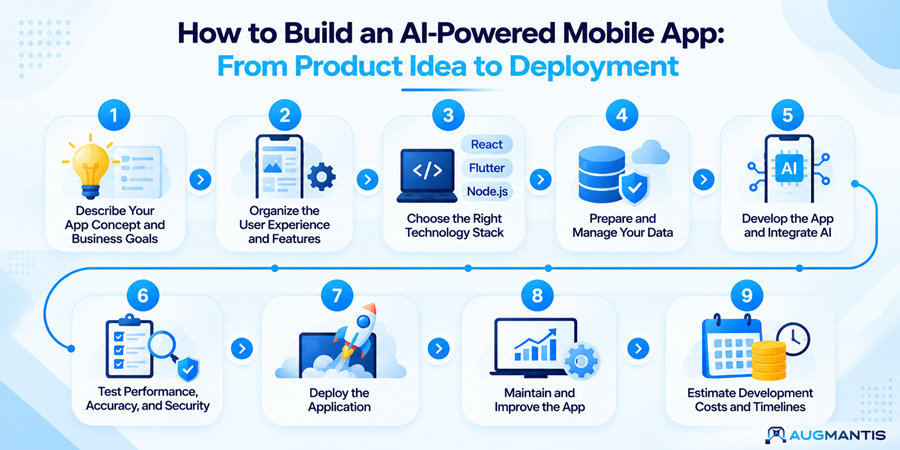
2. Organize the User Experience and Features
After confirming the idea’s validity, choose the ways through which the users will engage with the application. The functionalities of AI must make the process easier rather than complicating it.
The best AI mobile app development company can assist you in finding suitable functionalities for your application according to users' expectations and business objectives.
Choose the Right AI Features
In certain use cases, some functionalities that would be considered helpful include:
- Recommendations: Recommend items or media based on user preferences.
- Chat assistants: Provide answers and help navigate an app’s functionality.
- Forecasting: Recognize patterns that can be used to forecast future occurrences.
- Visual search: Recognize images.
- Speech recognition: Recognize voices and allow for voice-based navigation.
Design an Intuitive Interface
Make sure that the navigation is easy and make it clear what each AI feature can accomplish. Give the users the ability to change the inaccurate suggestions and also revert back to manual work if needed.
Simplifying the interface and AI interactions will make the technology easier for the users to handle.
Also Read: AI Development Services: Cost, Process & ROI Explained
3. Choose the Right Technology Stack
The technology stack affects development of the application, communication between different parts of the application, and scalability of the application. Early selection of the proper tools will help avoid future problems with maintenance.
Select a Mobile Development Approach
There are usually three ways that businesses will select from:
- Development using a native approach: Develop applications separately for iOS and Android systems to utilize their features.
- Cross-platform development: Make use of tools such as Flutter and React Native to build cross-platform applications.
- Progressive web applications: Provide an app-like experience through a browser.
It all depends on the required performance, budget, and maintenance, among other factors. Experienced Mobile App Developers in the USA can help you with your analysis in this regard.
Select AI Models and Tools
Functionality for AI may be based on using any one of these existing models, third-party APIs, open-source models, and even a custom-trained system.
In the case of a chatbot, a language model may be used through the API, whereas visual search requires computer vision. In cases where the application is dealing with special business data, RAG may be useful.
Pick the technology based on your business problem instead of complicating things unnecessarily.
4. Prepare and Manage Your Data
The use of AI applications requires relevant, precise, and reliable information. The recommendations, forecasts, and generated responses tend to be more valuable with regard to their structured information.
Organize Relevant Data
The choice of data types that the application will use to provide its functionality will be decided based on the purpose of the application.
Remove duplicates, fix inconsistencies, and deal with missing information. If any knowledge sources have been used by the application, set up procedures for updating the information.
Protect User Privacy
Utilize encryption techniques, access restrictions, suitable data retention policies, and consent forms. Gather only the data that is required for the desired function. Business organizations that are developing custom AI app solutions must also consider the manner in which third-party artificial intelligence companies handle submitted data.
5. Develop the App and Integrate AI
After establishing the requirements and the architectural structure, the development phase will include integrating the mobile interface with the back-end services, databases, and AI technologies. Reliable mobile app development services may be able to assist with this integration process.
Build the Frontend and Backend
The front end comprises the screens, navigation, and user interaction. The back end includes authentication, business logic, database transactions, and interfacing with other systems.
A good back end shields critical processes, ensures robust data manipulation, and facilitates scalability in the future.
Integrate AI Capabilities
AI capabilities can be linked via APIs, cloud services, or models that run in a secure environment.
Ready to Implement AI in Your Business?
From strategy to deployment, Augmantis helps you integrate AI into your workflows with scalable, future-ready solutions designed for real business growth.
Get Started with AI →For instance, when the user asks a question in a shopping application, the backend will authenticate the request, fetch product data, forward the required context to an AI service, and get a response back.
Error handling, rate limiting, and fallback procedures should be implemented in case of slow responses or unavailable services. Significant decisions require human intervention where needed.
6. Test Performance, Accuracy, and Security
It helps detect issues prior to the application being used by customers. AI app development services in USA should consider both the testing of the software and also the testing of AI performance.
Test Application Functionality
Make sure that functions such as account registration, log-in, browsing, payments, notifications, and others work properly. Check how the application works on different devices and operating systems under any network conditions.
Evaluate AI Performance
Test the capabilities of the AI system against real-world user needs. According to the type of application being developed, assess:
- Recommendations’ accuracy and relevance.
- Generated response reliability.
- Time and consistency of responses.
- The performance in different user scenarios.
- Robustness against misleading input data.
Security testing should also consider issues of authentication, API security, and unauthorized access.
7. Deploy the Application
Deployment enables making the application available for use. Ensure that before deployment, the system infrastructure is capable of handling the load and the monitoring is up and running.
AI-powered mobile application development Needs Deployment Planning from the Start Rather Than at the End.
Prepare for Launch
For iOS and Android apps, create the app listing, screenshots, privacy policy, permissions, and setup for release.
A beta release or rollout can help in finding any issues before the application is available to a broader range of users.
Monitor the Initial Release
Monitor application crashes, API errors, response times, user feedback, and AI efficiency. Establish usage thresholds and cost warnings for AI APIs, storage, and computational resources.
Monitoring will assist developers in identifying issues and keeping users' experience uninterrupted.
8. Maintain and Improve the App
Deployment is not the last phase. Maintenance ensures that the software application remains secure, functional, and adaptable to new technology advancements.
Track Performance and User Feedback
Measure active users, user retention, feature usage, and task completion. For artificial intelligence, measure response quality, latency, failures, and cost to use.
Such information helps in knowing which features work well and which need improvement.
Update AI Models and Infrastructure
Ensure that any new test models meet the required benchmarks of quality before deployment. Make sure that application dependencies and security features remain current.
As demand increases, database optimization and other computing considerations might become necessary.
9. Estimate Development Costs and Timelines
It depends upon application complexities, requirements of AI, integrations, and infrastructure needs.
Factors That Affect Development Costs
These important considerations are:
- Complexity and number of app functionalities.
- Use of native vs. cross-platform technology.
- Selection and customization of the AI model.
- Preparation of data and other integrations.
- Security considerations and testing needs.
- The use of cloud infrastructure and AI technology after deployment.
Building an MVP allows companies to test their concepts before investing in building a full-fledged application. This approach involves developing only the core functionalities and a few powerful AI functionalities.
Conclusion
Creating a smart mobile application is based on the presence of a product vision, appropriate technologies, proper data, testing, and improvement. A well-organized approach to development enables companies to build applications that solve the problems of users in a secure and scalable way.
Augmantis can help companies explore AI product opportunities and develop intelligent application experiences according to their needs. An initial idea with the right strategy can result in a useful mobile application.
Also Read: How to Implement AI in Your Business: Step-by-Step Guide 2026
FAQs
1. How is an AI-enabled mobile app developed?
Problem definition, selection of AI capabilities, choosing the tech stack, preparing data, creating the application, testing its performance, and deploying it.
2. How costly is an AI-enabled mobile app?
The cost of development depends on several factors such as app complexity, AI models, integrations, security, and infrastructure. Creating an MVP can help manage costs.
3. Which AI technologies are leveraged in mobile applications?
Machine learning, natural language processing, computer vision, recommendation, and generative AI are some of the AI technologies leveraged in mobile apps.
4. How much time does it take to create an AI mobile application?
A straightforward MVP may require several months, whereas a more complicated application that involves custom models and integrations may require much more time.
5. How do you maintain an AI-based mobile application?
Keep track of performance, review AI outcomes, solve any security-related problems, update models and data if necessary, and rely on users’ feedback for improvement.

Related Blogs