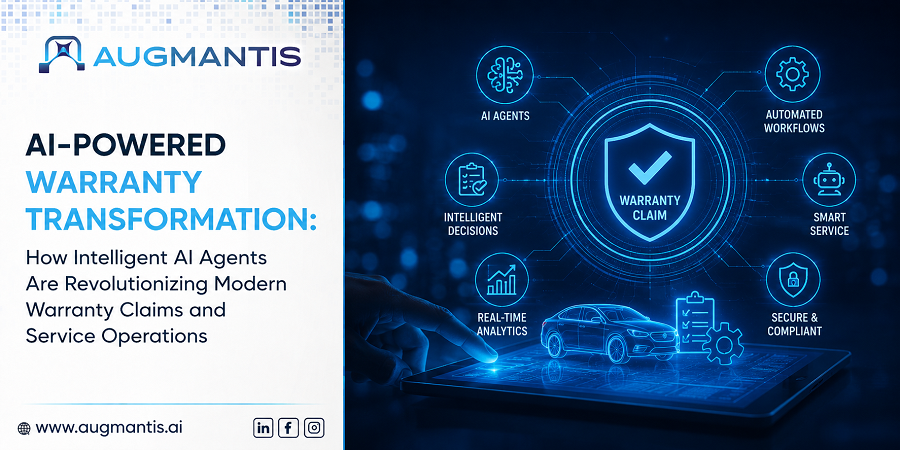
Imagine a warranty claim that would traditionally require three weeks to sort out, thanks to emails, manual checks, and spreadsheets, being settled in less than three minutes without any human-to-human interaction at all. This is no futuristic prediction. This process is going on right now in warehouses, call centers, and service networks throughout America, thanks to next-generation AI agents. For years, warranty management was the hidden cost center nobody wanted to address: slow, cumbersome, prone to both fraud and mistakes. Now, AI solutions for warranty are reversing the whole paradigm and making the process proactive.
Let’s discuss the impact of AI-powered warranty management on claims processing, service operations, and customer experience, and why progressive enterprises are scrambling to get in on it.
The Warranty Problem That's Costing Enterprises Millions
Legacy warranty processes have been designed to work in a more modest, manageable world. In the wake of growing product volumes, SKU numbers, and customer demands, the legacy systems have struggled to keep up due to:
- Manual claim filing involving agents reading claims in the form of PDFs, emails, and receipts
- Unreliable fraud detection causing loss of billions of dollars a year in invalid or duplicate claims
- Isolated data silos between manufacturers, retailers, and service providers
- Slower response time, angering customers and undermining customer loyalty
- Insufficient data visibility regarding failure trends, component failures, and repair costs
This list of problems is precisely why AI warranty management solutions have become boardroom concerns within the last two years.
What Are AI Agents in Warranty Management?
The AI agent is an autonomous or semiautonomous software program capable of perceiving information, processing it, and acting on it without being directed by humans to click buttons. While the automation script cannot do these things, AI agents for warranty management can perceive, process, compare, validate, identify any abnormalities, and even interact with the customer in real-time.
How This Differs From Legacy Automation?
Old school warranty software can help automate a process if every single step is known. But what is truly innovative about AI agents is that they handle exceptions, uncertainty, and judgement cases just as a claims adjuster would have.
A Practical Example
Think of a national appliance chain that processes 40,000 warranty claims per month. An AI agent would:
- Extract data from an uploaded receipt or invoice image
- Validate the product's warranty status against manufacturer records
- Flag suspicious patterns (e.g., the same serial number claimed twice)
- Auto-approve straightforward claims and route complex ones to a human reviewer with full context attached
The process that used to take five people a whole week is now done non-stop.
Key AI Solutions for Warranty Operations
- Automated Claims Process for Intelligence
Using enterprise AI warranty claims processing platforms for businesses, NLP and computer vision technologies are used for reading claim documents, matching them with policy records, and providing an instant decision in seconds compared to days previously taken.
- Prediction for Component Failure
The predictive failure analysis can help in predicting the components that might fail based on historical claims, sensors, and usage of products.
- Fraud and Anomalies Detection
With the help of machine learning algorithms based on historical data, AI can detect duplicate serial numbers, wrong purchase dates, and any statistical anomalies in claims.
- Chatbots for Customer Support
Voice and chat AI assistants can help customers file claims, check the status, or schedule a repair without taking the burden off call centers, while increasing satisfaction ratings.
Real-World Example
An HVAC company installed an AI assistant that managed its inbound service requests. Within four months, the number of resolved cases on the first call increased by 34%, and the number of fake claims decreased by almost 20%.
Why Enterprises Are Investing in AI-Powered Warranty Operations?
This move to AI-powered warranty operations is not merely aimed at reducing costs but at creating a point of competitive differentiation, as customers who get their claims settled quickly and efficiently develop greater trust in the company, resulting in repeat business.
Business Benefits at a Glance
- Faster resolutions from days to minutes
- Lower fraud losses through pattern recognition
- Higher customer satisfaction via self-service and instant updates
- Actionable product insights for R&D and quality teams
- Scalability without proportionally increasing headcount
Custom AI Agent Development: Build vs. Buy
Custom AI agents become relevant when there is a need for bespoke processes, policy structures, older ERP systems, or specific industry compliance requirements. In such cases, custom AI agent development services allow you to create an agent that can integrate seamlessly with your current technology stack, such as Salesforce, SAP, ServiceNow, or custom claims systems.
What a Custom Build Typically Includes?
- Discovery and mapping of existing claims workflow
- Integration with the company's databases and third-party APIs
- Model training on company-specific claims history
- Human in the loop for exceptions
- Continuous monitoring and model retraining
Why US Warranty Providers Are Turning to Specialized AI Partners?
Taking into consideration the complexities involved in compliance, data privacy, and integration, most firms seek to acquire AI solutions for US warranty providers from vendors who have an understanding of the intricacies associated with technology as well as regulation. This is resulting in increased demand for firms that provide warranty claims automation for US providers with ROI – not just a chatbot solution integrated into a legacy platform.
Choosing the Right Development Partner
When assessing a potential partner, ensure they have demonstrated experience with:
- Document intelligence and data extraction via OCR
- LLM-driven reasoning agents with guardrails
- Secure, compliant data management (SOC 2, HIPAA as appropriate)
- Post-launch service and model tuning
For firms that want to explore such a partnership, there is added value when dealing with a reputable AI development company in Chicago USA, since they possess extensive knowledge about enterprise software development along with the practical know-how of creating agentic AI solutions for logistics, retail, and manufacturing warranties.
Measuring ROI: How to Evaluate AI Warranty Management Success
While the use of AI warranty management solutions can be seen as one-half of the answer to measuring ROI, it is also important for businesses to have a system in place to prove that the use of AI solutions has indeed proven beneficial. There are too many companies that implement automation and fail to re-evaluate its impact on their business performance.
Core Metrics to Track
- Resolution Time for Average Claims – comparison of cycle times pre- and post-automation
- First Contact Resolution Rate – number of claims that are resolved without escalation
- Reduction in Fraud and Leakage – amount of money saved from fraudulent claims detected
- Cost to process each claim – taking into account software, staff, and overhead costs
- Customer Satisfaction – CSAT/NPS after resolving claims
A Real-World Benchmark
An electronics retailer operating within a region that implemented enterprise AI warranty for claims processing monitored cost per claim pre-implementation versus post-implementation. In less than six months, cost per claim fell by almost 40%, and customer satisfaction scores improved in the two digits for warranty claims. This is clear evidence that automation benefits can be measured just like any other business objective.
Implementation Roadmap: Getting Started with AI Agents for Warranty Management
Deployment of AI Agents for Warranty Management does not always have to be a drastic process of making a major change. The most successful ones are the ones that use a phased approach in building confidence.
A Practical Rollout Framework
- Identify current workflows — identify each manual step in the existing claims process.
- Narrow down the scope first — start automation on a single claim type or product category.
- Keep people in the picture — send any claims with low confidence to review until the model is more accurate.
- Scale up gradually — add more claim types, languages, or channels as the accuracy increases.
- Retrain models continuously — use the new claims data to improve the accuracy of predictions.
Example Rollout Timeline
The middle-sized furniture manufacturer used a phased approach of rolling out an AI-based intake process initially for just one product line for eight weeks, verifying its accuracy to match that of human reviewers before implementing it on all products, which took just six months compared to a disruptive implementation.
Also Read: How to Implement AI in Your Business: Step-by-Step Guide 2026?
The Road Ahead: What's Next for AI Warranty Management Solutions
The next wave of innovation would comprise:
- Multi-agent orchestration wherein specific agents deal with intake, validation, anti-fraud detection, and payouts
- IoT integration that enables devices to alert about failure and initiate claims without the consumer becoming aware of it
- Customer engagement using Generative AI that can send personalized, empathetic claim updates at scale
Adopting such innovations would help organizations not only reduce costs but create a competitive advantage out of their warranty programs rather than treating them as an operational expense.
Ready to Implement AI in Your Business?
From strategy to deployment, Augmantis helps you integrate AI into your workflows with scalable, future-ready solutions designed for real business growth.
Get Started with AI →Also Read: AI Development Services: Cost, Process & ROI Explained
Final Words
Warranty management is not just an operational activity anymore; it is a mirror of how much the brand respects the customer’s time and loyalty. Those organizations that are ahead of others in this change are precisely those brands that use AI solutions for warranty as an investment opportunity rather than a band-aid solution by incorporating smart agents from the intake process, verification process, anti-fraud protection, and resolution. Regardless of whether you choose a plug-and-play solution or use custom AI agent development services for integration with your system, the result will be identical – quicker claims processing, decreased loss, and more satisfied customers. With AI-powered warranty management growing more advanced, the difference between automation with AI and those who stick to manual work will become even more apparent.
Frequently Asked Questions
1. What is AI-based warranty management?
AI-based warranty management leverages machine learning and intelligent agents for claims intake, validation, fraud detection, and resolution, thus increasing efficiency and speeding up service delivery.
2. How do intelligent agents facilitate warranty claims processing?
Intelligent agents process documents, verify warranty status, detect any anomalies, and provide recommendations regarding claims in real time, thus reducing the processing time from days to minutes.
3. Is it possible to reduce warranty fraud with the help of AI?
Yes. Machine learning algorithms are capable of detecting duplicate claims, incorrect serial numbers, etc., which is rather complicated to notice for humans.
4. What are the advantages of custom AI agents compared to pre-built software?
In the case of organizations having unique workflows or legacy processes, custom multi AI agents are always preferred because the return on investment is usually higher due to the customization of the tool according to existing processes.
5. Which industries can benefit from AI warranty management software?
Industries such as manufacturing, electronics, automobiles, home appliances, and consumer products get the maximum benefit from the use of warranty management software based on artificial intelligence.
6. How can I select a good partner for AI development?
A good AI development partner must have experience in document intelligence and secure data handling capabilities.

Related Blogs