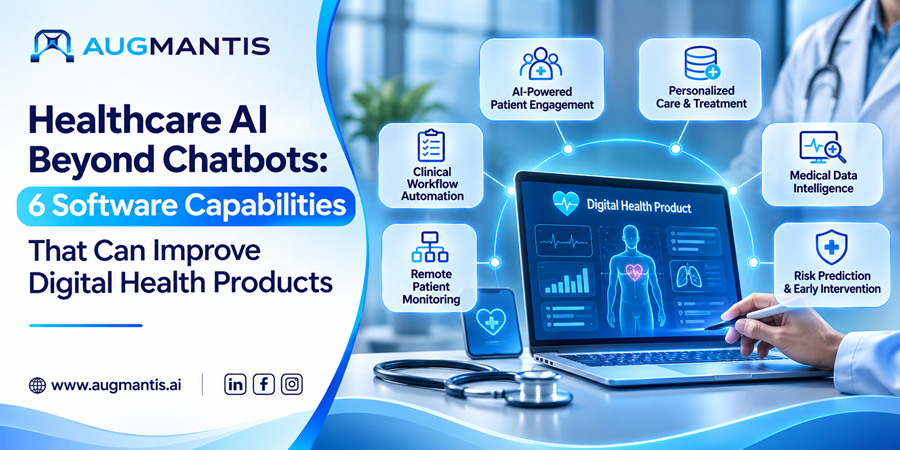
For many companies, chatbots were the first concrete step into using AI in healthcare. Enter your symptoms, receive your answers, schedule an appointment. It's a great start, but there is so much more potential in this technology. All the benefits lie further down the stack in features that help to lighten clinician burden, identify risks, and make all interactions more relevant to patients.
If you are developing a digital health tool or implementing AI in healthcare into your current digital health tool, consider including any of the following six features in your roadmap. Each one solves a different problem and can be added to your system without a total rework.
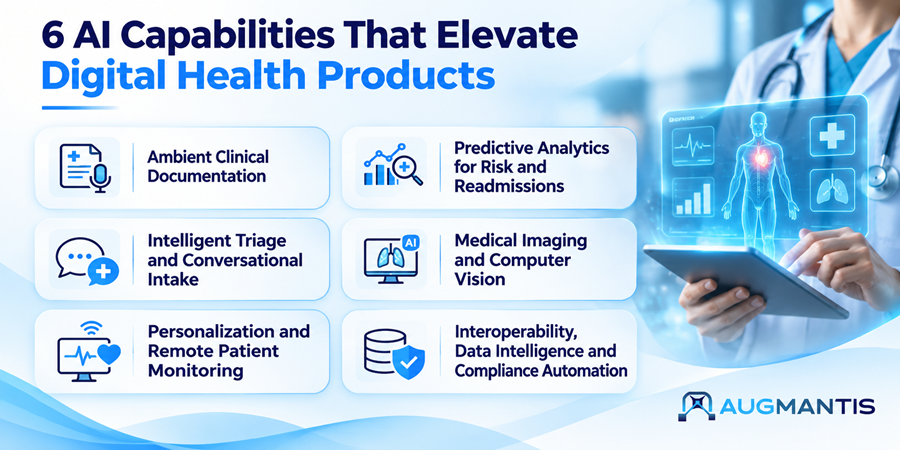
1. Ambient Clinical Documentation
The Problem It Solves
Medical providers spend most of their time on documentation rather than tending to patients. Documentation is one of the major causes of clinician burnout and also acts as a barrier for all workflows centered on the electronic health record system.
How the Capability Works
Ambient Documentation, which is a popular application area of AI software development for healthcare, utilizes speech recognition capabilities and language models in order to listen to a patient consultation, filter out any non-clinical conversations, and generate a structured document that will be reviewed by a clinician. The ideal system maps its results directly into the proper fields in the record, saving the need to manually copy anything.
What Product Teams Should Know
This is a good illustration of why AI software development for healthcare requires more than just a generic framework. Medical accuracy, ability to cope with accents and different specializations, and a review and signature stage are vital components. The teams that develop their own frameworks from the very beginning have already set the boundaries, created the audit trails, and built feedback systems.
2. Predictive Analytics for Risk and Readmissions
The Problem It Solves
Care remains mostly reactionary. A patient gets worse, has to be readmitted, or misses an important follow-up appointment, and then something gets done.
How the Capability Works
The use of predictive models in AI-powered healthcare solutions involves looking at past and current data, including vitals, lab tests, medication history, and social factors, to predict which patient is more susceptible to having an adverse outcome. This does not result in any diagnosis but in prioritized actions.
What Product Teams Should Know
For AI-powered healthcare solutions that predict risk, the usefulness of the predictions depends on making sure the predictions reach the appropriate individuals at the appropriate time. This requires surfacing the scores within the current workflow, identifying the main contributors to the score, and enabling clinicians to record the utility of the alert. It is also important to track model drift.
3. Intelligent Triage and Conversational Intake
The Problem It Solves
People usually have no idea if they should go to the emergency department, make an appointment on that day, or just be told what to do by themselves. The receptionists and nurses answer all questions.
How the Capability Works
The application of modern triage, an excellent case study for AI chatbot development services, is far more sophisticated than simply applying a decision tree. It involves natural language processing with clinical protocols and adaptive questioning, and ensures that the patient is correctly routed to the appropriate level of care. This process can even begin before the visit.
What Product Teams Should Know
Conversations remain meaningful even when they are integrated into actual systems like scheduling and the path to a human via the record and escalation process. When looking for developers to create an AI-based chatbot, teams need to consider the following questions: How will the handover from the bot to the human happen? What kind of ambiguity does the bot deal with? How are safety policies tested?
Also Read: AI in Healthcare Software Development: 7 Practical Use Cases Beyond Chatbots
4. Medical Imaging and Computer Vision
The Problem It Solves
Radiologists, dermatologists, ophthalmologists, and pathologists all generate massive amounts of images. There are few specialists, and this delays treatment due to long turnaround times.
How the Capability Works
Some of the AI applications that can be used in medicine include computer vision applications that can flag suspicious areas, prioritize urgent tests within a reading queue, and measure structures consistently while comparing them to previous images. The role of the model is usually supplementary to that of the expert.
What Product Teams Should Know
Some of the AI solutions for healthcare in this category are governed by regulators, which means that you should factor in validation data and intended use right from the beginning. A good application will also point out areas where it is less reliable, including unusual image quality or demographic under-representation.
5. Personalization and Remote Patient Monitoring
The Problem It Solves
Generic messages and standardized content reduce engagement levels, particularly among patients with chronic illnesses between appointments.
How the Capability Works
Personal information is collected through wearables and household gadgets in the form of data such as blood glucose level, heart rate, blood pressure, and physical activity. The machine learning technology identifies the baseline of the individual, notices any significant change, and adapts the nudges, education, and care plan according to that individual.
What Product Teams Should Know
The primary danger is alert fatigue. Thresholds must be adjusted so that any clinically significant change makes its way to care providers. At the same time, patients need to be provided with feedback on their performance. The more personalization feels like an act of support rather than intrusion, the better.
6. Interoperability, Data Intelligence and Compliance Automation
The Problem It Solves
In regard to healthcare AI solutions in USA, health data exists in numerous forms throughout various sources, including records, labs, payers, devices, and legacy systems. If there is no structured and linked data, all other capabilities function poorly.
How the Capability Works
AI can help by pulling structured data from faxes, PDFs, and unstructured documents, connecting patient information from different systems, translating codes between formats such as FHIR and HL7, and identifying potential privacy concerns even before data sharing takes place. The system can also support coding suggestions, prior authorization forms, and audits.
What Product Teams Should Know
Those who evaluate healthcare AI solutions in USA would want HIPAA-compliant security measures, role-based access control, encryption, de-identification if applicable, and auditing logs for who accessed what data. Vendors who cannot showcase such controls in their AI product, despite its capabilities, would fail the security evaluations.
How to Choose Where to Start
You don’t have to implement all six capabilities at once. Begin with the challenge that is most difficult and easily measurable first, such as time spent on documentation, no-show rate, and readmission rate. Conduct an isolated pilot, set metrics before the launch, and involve physicians in testing from the very beginning. Move to the next capabilities based on the shared data layer, and think about working with a healthcare app development company in USA to sequence those.
A specialized partner may help you with that. A healthcare app development company has a lot of experience in building clinical applications, knows everything about regulatory requirements and integration with major record systems, which allows them to shorten the path from a prototype to an application that real care teams can use. When choosing between different partners, ask them for an example of the delivered application and approach to validation and further product support.
Also Read: AI in Healthcare: From Chatbots to Intelligent Workflows
FAQ
1. What does healthcare AI mean aside from chatbots?
Ready to Implement AI in Your Business?
From strategy to deployment, Augmantis helps you integrate AI into your workflows with scalable, future-ready solutions designed for real business growth.
Get Started with AI →AI capabilities are those that go on behind the scenes in the digital health product, like clinical documentation, risk predictions, medical imaging, remote monitoring, triage, and interoperability. They help boost effectiveness and efficiency in the product but do not need the conversation aspect.
2. What is the ideal AI capability for my digital health product?
Select the one that can address the measurable pain point in your product. If you have a clinician-facing product, you can try out documentation automation; if it is population health, go for predictive analytics; while chronic care needs remote monitoring. Do a pilot project at first, then scale up after showing success.
3. Can AI in digital health products be used safely and appropriately?
Yes, when you design the AI system with the proper measures. It includes HIPAA-compliant data management, clinical outputs' human oversight, bias testing, audits and performance monitoring. Some systems, mainly diagnostic tools, might need an FDA evaluation for use depending on the application.
4. How much time does it take to implement AI capabilities into the existing healthcare application?
Pilot implementation of AI typically requires several months depending on data quality and the integration process. However, simple AI applications, for instance, intake automation, can be delivered more quickly than image analysis or prediction models that require a validation period.
5. Could AI replace clinicians in digital health?
No, clinicians are still responsible for the final decision-making process. They diagnose patients and make final treatment decisions. AI is more effective when it supports the decision-making process by doing repetitive work and detecting potential risks.

Related Blogs