What if your store could function more intelligently, even while you go to bed? This is exactly what artificial intelligence in retail makes possible.
Many people assume that AI simply recommends products, "you may also like." However, AI does much more today. AI can establish intelligent pricing, handle inventory, communicate with customers, create product descriptions, and detect fraud.
The good news is that you do not have to be an IT specialist. Regardless of whether you operate a small online store or a growing retail business, AI can save you time, money, and improve customer experience.
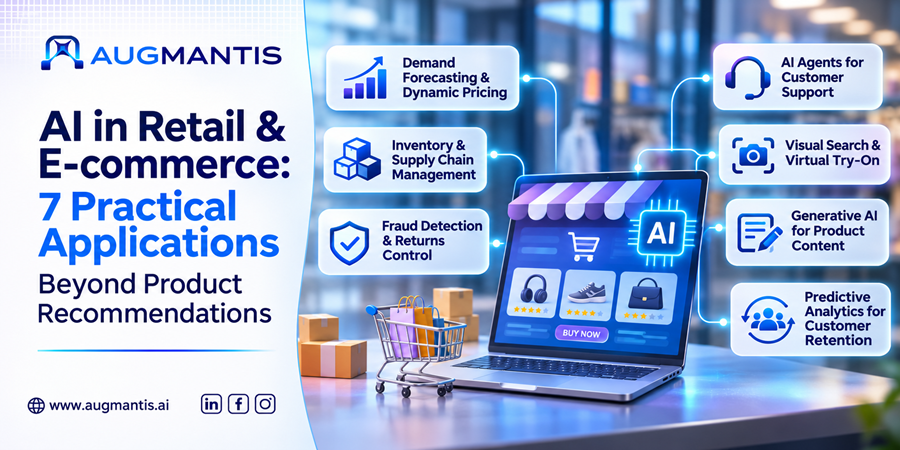
These are the seven practical applications of AI we will discuss:
- Demand forecasting and dynamic pricing
- Inventory and supply chain management
- Fraud detection and returns management
- Customer support using AI agents
- Visual search and virtual try-ons
- Generative AI for product content
- Customer retention using predictive analytics
All have easy descriptions, practical examples, and fast hacks to begin. Let's take a look:
1. Demand Forecasting and Dynamic Pricing
Guessing demand comes at a cost. Purchase more and money gets locked up in excess inventory. Buy too little, and customers visit a competing establishment.
AI analyzes past sales, seasons, weather conditions, and regional events to foresee the products that will sell, in which regions, and during which times. Moreover, it is capable of automatically adjusting the prices within the range you define, thus ensuring that your top-selling products remain profitable and the underperformers do not get out of stock.
Our smart AI solutions for retail and ecommerce always leave humans in charge. You establish the minimum and maximum prices, brand policies, and guidelines that automation follows. Seasonal spikes become less nerve-wracking because predictions take into account the early signals from the market.
How It Helps?
- Less shelf waste and less panic discounting
- Higher gross margins on your best sellers
- Improved preparation for the holiday and sale seasons
Where to Start?
Integrate an easy-to-use forecasting technique into your sales data and perform tests on a single product line.
2. Inventory and Supply Chain Management
The timely delivery of any products comes from the web of warehouses, transportation, and suppliers. AI assists in disentangling this. It may suggest an optimal amount to order, choose an appropriate warehouse for every order, and make alternative delivery paths whenever a delay is detected.
Moreover, cameras and scanners will detect lost and misplaced items; therefore, there is no need to count your inventory manually. Your inventory data stays accurate regardless of the amount of labor needed to achieve it. As time passes, the system gets accustomed to your peculiarities; hence, it becomes better at making suggestions about the amount to order and detecting delays.
This is where AI automation for retail and ecommerce delivers results fast. Simple tasks like creating purchase orders and notifying suppliers about them become automated and work in the background.
How It Helps?
- Less likelihood of stockouts and reduced storage fees
- Speedy and dependable shipping assurance
- Negotiating better prices from suppliers with actual lead times
Where to Start?
Integrate all inventory, ordering, and supplier data on a single platform.
3. Fraud Detection and Returns Control
Fraud and refunds stealthily erode profits on a monthly basis. Artificial Intelligence performs analysis in milliseconds by analyzing devices, locations, shopping behavior, and payment data against known risk markers.
Riskier orders are filtered through for further investigation while legitimate users have seamless payment experiences. Such an approach is vital since incorrectly blocked payments may result in loss of sales and potentially good customers.
AI ecommerce software development in USA is a choice for numerous growing businesses that want such security measures built into their payment system. Protection offered by these systems is not generic but tailored according to risks faced by each particular business. Moreover, such solutions grow more efficient as time passes and the system learns from additional cases.
How It Helps?
- Detection of abuse becomes simpler
- With improved size guidelines, fewer will be returned
- Review groups will concentrate on the really uncertain orders
Where to Start?
Analyze the leading causes of your chargebacks and returns and then address the largest problem.
4. AI Agents for Customer Support
Earlier chatbots implied limited scripts and no alternatives. The current AI agents are capable of comprehending natural language, checking the order status, managing exchanges, and answering customers' questions about products with help from your own catalog and policies.
In case the conversation becomes complicated, it is forwarded to the human agent with all the history included. Your customers never need to repeat themselves, and your team receives all necessary background information.
Increasing interest in AI Agents for e-commerce in USA is due to the following facts: customers demand prompt answers, and round-the-clock work involves considerable expenses. Besides, the agents may perform the role of shopping assistants who help the buyers to choose products or to purchase gifts within budget.
How It Helps?
- Immediate response at any time of the day
- Faster service time with reduced ticket repetition
- Additional time for your team to deal with delicate situations
Where to Start?
Create automation for your five most asked questions, like order tracking and returns.
5. Visual Search and Virtual Try-On
Not all customers may find the proper keywords to search for something they want. Visual search allows customers to upload a photo of the sofa they liked and see similar products right away from your store.
Virtual try-on is even better. Customers can virtually try on glasses, cosmetics, or clothes using their phone camera before buying something. It becomes easier to make up one's mind about the product once it is viewed in context.
While exploring the possibilities of AI retail solutions in the USA, most brands list the use of visual technologies among the top priorities since the positive effect is quite easy to observe and measure. There are many plugins available that would work perfectly well with the widely used storefront platforms. Start with the goods customers may have difficulty describing.
How It Helps?
- More engagement and increased conversion rates
- Lower return rates because shoppers are confident
- An exciting and trendy environment that breeds loyalty
Where to Start?
Test just one product category such as eyewear or interior design products, and see how conversion and return rates compare beforehand and afterwards.
6. Generative AI for Product Content?
Writing thousands of products, ads, and email messages manually is not scalable. Generative AI for retail and ecommerce will help you generate product copy, translate product listings into other languages, design variations of a campaign, as well as generate lifestyle images based on basic product photos.
Ready to Implement AI in Your Business?
From strategy to deployment, Augmantis helps you integrate AI into your workflows with scalable, future-ready solutions designed for real business growth.
Get Started with AI →It also enables you to move fast. New seasons and flash sales become much easier, as you can produce the necessary content in a single day since the idea was approved.
The most optimal way of using the technology is combining speed with control. Provide the AI with your brand voice and validated product information, and have an editor check all of this before releasing it. You may also produce several variations of one message and test what wording performs better.
How It Helps?
- Immediate content preparation in minutes rather than days
- Effortless testing of headlines, images, and subject lines
- Small teams can compete on quantity with large teams
Where to Start?
First drafts of product descriptions should use AI, and after that, editing can be done.
7. Predictive Analytics for Customer Retention
Who will churn in the near future is better information than which customers have left. Models are used to estimate lifetime value, identify those customers who are on their way out, and who will be responsive to offers.
Think of the loyalty program that gives the regular buyers early access, gently reminds the lapsed customers of what they are missing, and presents offers at the right time to the price-sensitive customers.
The above-mentioned is an example of a personalized experience that is truly helpful, not intrusive. AI in retail can transform customer data into customer relationships when based on consented first-party data.
How It Helps?
- Correct message at the correct time for the correct individual
- Less wastage of money through unnecessary discounts
- Loyalty programs customized for every member
Where to Start?
Identify the customers who haven’t purchased anything in 90 days and provide them with one customized offer.
How to Get Started With AI: 4 Simple Steps
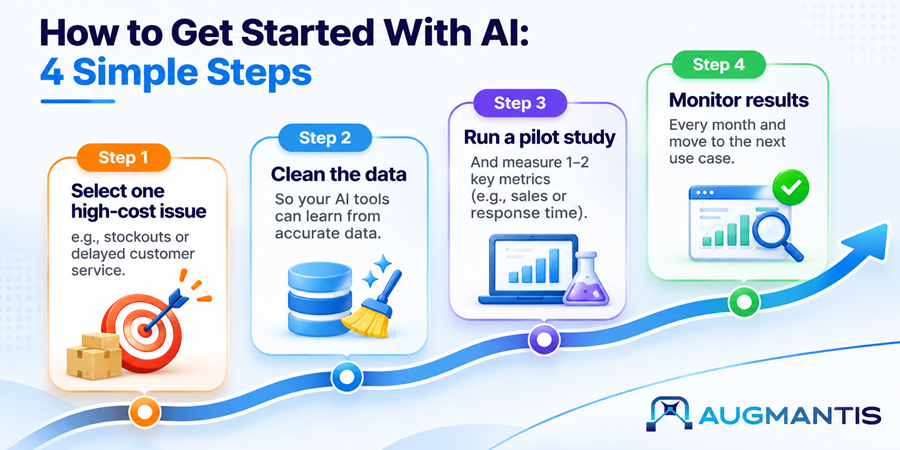
You don't need to do everything at once. Take these steps to start confidently:
- Select one high-cost issue; for instance, stockouts or delayed customer service responses.
- Clean the data so that your tools can learn from the clean data.
- Run a pilot study and measure just one or two metrics such as sales or time taken for responses.
- Monitor the results every month and move on to the next use case.
Small wins create confidence. Each pilot tells your team what’s working, where there’s room to improve your data, and delivers actual numbers that support the next move. Make sure to keep the human check in place when making decisions about pricing, content, and fraud prevention to avoid damaging your brand’s reputation. If you do this right, AI solutions for retail and e-commerce will become a reliable routine rather than an unpredictable experiment. Regardless of where you are in the process, be sure to share the results with your team.
Final Words
The application of AI in the retail industry is much broader than just offering product suggestions. These seven examples are practical, measurable, and easy to implement. The best approach is to start small – identify one challenge and prove the value before moving forward.
Remember, however, that technology by itself will never be the full solution. The most successful solutions arise when the combination of clearly defined objectives, good data, and a motivated team comes together, and when the customer understands that the use of AI makes their experience easier, faster, and more personalized.
It is critical to find the right partner to make this process efficient and smooth. Partnering with an AI development company in USA, like Augmantis, can be the right choice to discover use cases and build customized AI-powered solutions based on your data.
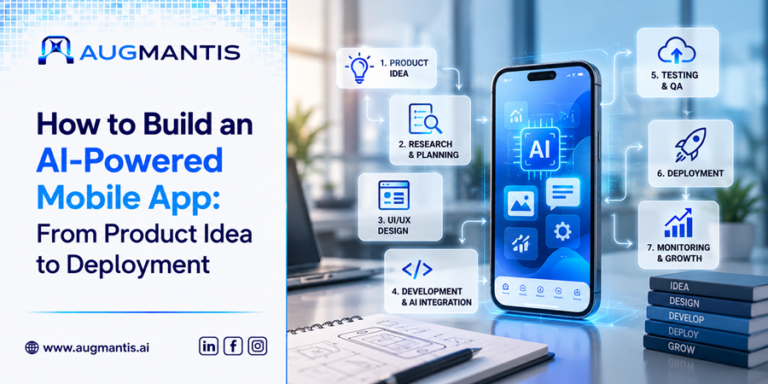
Also Read: How to Build an AI-Powered Mobile App: From Product Idea to Deployment
FAQs
- What are the applications of AI other than recommendations in retail?
Other areas where AI is used in retail include demand forecasting, dynamic pricing, inventory management, fraud prevention, customer support chatbots, visual search, content creation, and customer churn prediction. All those instruments work together, allowing retailers to make quicker and more informed decisions.
- Is it affordable for a small e-commerce company to implement AI?
It is. Most AI-based services are available either in ready-to-use form or in a monthly subscription format. A small retailer may start implementing one application area of AI, such as a support chatbot or AI-created product descriptions.
- Besides recommendations, what are the applications of AI in retail?
Other uses of AI in retail are demand forecasting, dynamic pricing, inventory management, fraud detection, chatbots, visual search, content creation, and churn prediction. All these tools help retailers make faster and better decisions.
- Is AI affordable for an e-commerce company?
Yes. Most AI services are already built-in or provided through monthly subscriptions. A small e-commerce business can implement AI using just one tool out of its possible applications, like customer support chatbots or AI-generated product descriptions.
- How long will it take to see the results?
Results can be expected within two weeks when implementing content generation or customer support. Other algorithms need a few months of good data gathering.

Related Blogs